
Sunday, October 2, 2011
"Girl Reading By A Window"
Over the years, artists have portrayed the reader and the act of reading in favorable light. Far more women than men have been photographed or painted as they read. Here is an excellent example. It is an oil painting by Edmund Charles Tarbell and is entitled "Girl Reading By A Window."


Thursday, June 30, 2011
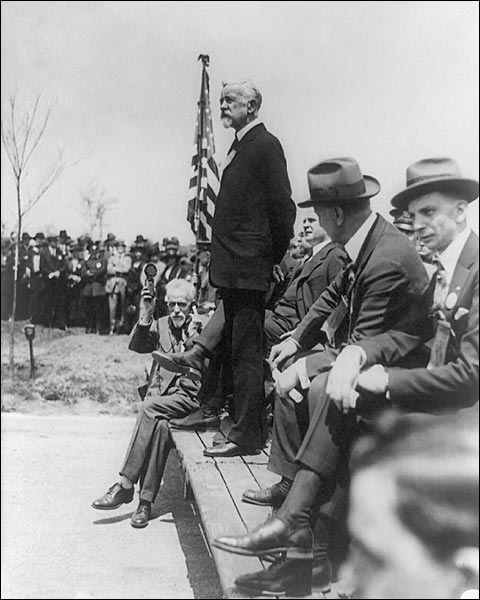
Henry Cabot Lodge's 4th of July Speech in Boston in 1879
Oration delivered before the City council and citizens of Boston, on the one hundred and third anniversary of the Declaration of American independence, July 4, 1879 by Henry Cabot Lodge at the Boston Theatre.
We meet to-day to commemorate, with customs honored in the observance, our national birthday. In this matter of birthdays, nations resemble individuals. The recurring anniversary is hailed in childhood with rejoicing and pleasure. It marks a period of rapid advance, and denotes another step towards manhood, and all its fancied independence. In due time the youth comes of age. Technically and legally, at least, the period of tutelage and immaturity is at an end. But with the acquisition of freedom a gradual change begins. Few persons go so far as Dean Swift, who passed his birthday in solitude, as a day of mourning, fasting, and prayer. Yet, to almost every one, I think, as he goes on in life, the birthday suggests more and more serious reflection. Gradually we turn our eyes, when the day arrives which closes each little cycle of our existence, from the future to the past. We strive more and more earnestly to draw from the departed years lessons which shall guide our footsteps upon the unknown pathway before us. If this be rightly done, it is at this period, when we have both a future and a past, that we achieve success.

So it is with nations. By the signatures of the Declaration of Independence we came into existence. By the signatures of the treaty of Paris, that existence was acknowledged in Europe. By the adoption of the Constitution, nationality, then only a possibility, became a probability, which, after many years, has ripened into certainty. Then came our boyhood, and the struggle to cast aside the colonial spirit, and shake ourselves free from the influence of older and stronger nations. This was a longer and more arduous process than we can readily realize now. If the world had been at peace, our task, wonderfully difficult under any circumstances, would have been somewhat simplified; but everything seemed to combine against us.
Civilized mankind was in the throes of the French revolution. Through the first period of that awful convulsion Washington and Hamilton and Adams steered us successfully into the haven offered by the peace of Amiens. There was a short lull, and then the tempest raged again more violently than before. The old pilots were gone, and there was no one who could fill their places in such stress and peril. We were the only important neutral nation in the world, and our rich and defenceless commerce was an inviting prey. We broke from our moorings, and drifted out upon the stormy seas of the Napoleonic wars, assailed by all, befriended by none. It was painfully evident then that we were still children, and still in tutelage, intellectually, if not physically. To our shame be it said, both political parties made it their principal business for ten years to accuse each other of foreign predilections. We displayed at every turn the violent anger and infirmity of purpose which characterize the headstrong and impetuous boy, whose powers are yet untried, and who lets " I dare not wait upon I would." It was a sorry time. . But the previous years of peace and union had not been useless. After sore humiliation and bitter insult had been tamely borne by the country a national party at last came into existence. They pushed aside the old leaders and the old provincial feelings, and resolved to fight. They acted blindly, hotly, and, in many ways, unwisely. They were not Washingtons, and could not imitate his policy. But they took the ' methods of the Federalists and the theories of the Democrats, and determined to assert their nationality by arms. In so doing they hurried the country into a desperate and losing war. They brought the Union to the verge of dissolution. They abandoned by treaty everything which they had sought to obtain by force. But they vindicated the national existence, they proved the fighting qualities of the race to be as fine as ever on sea, and at last on land, and they broke once for all the fetters of colonial thought and tradition. They did their work roughly and ignorantly, but they were right at, bottom, and by the treaty of Ghent we came of age.
Then followed a period of wild exuberance and exultant hope. By the almost magic growth of material prosperity, by the rapid spread of civilization, and by the new-born consciousness of nationality, men's minds were filled with visions of a political millennium. We became imbued with the belief that we had a great mission. All humanity was to come as to the promised land, and be relieved. The fertile imagination of Henry Clay devised the scheme of uniting all American States. This human freedom league, controlling the western hemisphere, was to resist the Holy Alliance of emperors and kings, and bring in the new world to redress the balance of the old. Doubts as to our system, or as to the perfection of humanity, when freed from oppressive government, were regarded as heresy. We were to reorganize society, and change the destiny of man. In our vanity, our self-confidence, our unwillingness to learn or to recognize and correct our faults, above all, in our morbid sensitiveness to ridicule, we showed only too clearly our youth and inexperience.
But, while we were rejoicing and looking forward to the beneficent and enchanted future, where our dreams were to become realities, a dark cloud was gathering over the prospect. Gradually it became evident that two distinct social systems had grown up within our borders, which were so wholly irreconcilable that even this broad land could not afford room for both. One must perish that the other might survive. With every advancing year the immutable laws of economy and industry widened and deepened the gulf between the opposing systems, and strengthened one side while they weakened the other. Free labor was stifled in an atmosphere where slaves breathed, and free labor held in its hands the destiny of the republic.
There might have been a time when this awful problem could have received a peaceable solution; but, when men were at last awakened to the facts, and prepared to deal with them, it was too late. Beneath the baneful influence of the slavery struggle, politics and public men degenerated, and the old statesmanship of the republic withered away. Great leaders, in Congress and elsewhere, cried, "Peace, peace;'' but there was no peace. Our social problem was a Gordian knot. We followed the example of Alexander, and untied it with the sword.
The greatest war of modern times, since Napoleon fled from the field at Waterloo, and all the far-reaching results of such a war, have made sad work with our illusions. They are gone, like our extreme youth, and we begin to turn our look backward for instruction as to the journey which once seemed so easy and so full of promise. We have reached the second stage in our national birthdays. The time for reflection has come. If we can profit by the teaching of the past, although the future no longer looks either so golden or so certain as of yore, we may still find in it a greater, better, and truer success even than that which once filled our youthful imaginings. On this day of the year it especially behooves us to make up our accounts and see how we stand. We may well pause for a moment in our hurried, nervous, busy life to contemplate the years which have gone, and see what we have done with them. We are growing old, old enough to have a history, old enough to study it carefully. Let us take, then.
That great, wise book, as beseemeth age,
While the shutters flap as the crosswind blows,
And we turn the page, and we turn the page,
Not verse, now, only prose.
We are in the very prime of life as a nation. We are still young, still growing, still plastic and able to learn. But we have also passed the period of immaturity; we are vigorous, powerful, rich, and masters of a continent. We have made for ourselves a history, and we have our heroes and our heroic age, — an age full of human passion and human error, but great by its struggles and its conquest of difficulties.
We are wont to revert to the war for independence as our most glorious time. So, in some respects, it was. But the Declaration of Independence is eclipsed by the adoption of the Constitution and the organization of the government. It is better to create than to destroy. If we had fought the Revolution merely to obtain the wretched Confederation, and then dissolve into petty and jarring States, it would have been more honorable to have remained an integral part of the great empire of England. But this was not to be. We proved ourselves worthy of our inheritance, and capable of the moderation, temperance, and foresight which resulted in the Constitution. With the inauguration of Washington our national existence became a fact, and to the history of-, our career from that time to this we must look for guidance and instruction.
Although history, as a science, is still in its infancy, we have gone far enough to perceive a few great laws of human development, and from these, as they are the greatest and simplest, we learn the most, our own history we can easily detect the governing forces which have shaped our destiny, and struggle for victory. Two great conflicts of opposing principles have gone on here side by side. Nationality and separatism, aristocracy and democracy, are the contending forces which have made the political history of the country, and been felt throughout society and all its manifold forms of activity. All these forces existed in the States of the Confederation. They were present at the debates on the Constitution, and, from the foundation of the government, they have battled for the great prize of its possession and administration.
In the old system of the Confederation the separatist principle was supreme. Every State looked out for its own immediate interest with selfish and short-sighted ingenuity. The general government was despised and rejected. Anarchy seemed at hand. By a grand effort the wisest and most patriotic men framed and carried the Constitution. They succeeded, by means of judicious compromises, in "extorting from the grinding necessity of a reluctant people" a bare assent to the new scheme. Whatever glosses may now be put upon the Constitution, and upon the debates which preceded it, there can be no doubt that it was regarded at the time not only as an experiment, but as an agreement. Irrationality had but a feeble life in 1789, when the first Congress met in New York. There is no need to dwell upon the growth of the national principle embodied in the Constitution, or the phases of the conflict which ensued between that principle and the older one of State sovereignty. They, at last, contended for dominion sword in hand, and the events which led to four years of civil war are as familiar as a twice-told tale.
Everyone knows that, with each advance of the national power, the separatist spirit started up with fiercer menace and contested the ground. Sometimes the State prevailed, and sometimes the nation. Finally the rights of States were appropriated to the service of slavery, which gathered to itself every interest and every passion almost of which human nature is capable. At last slavery drew the sword of State rights and struck at the national existence. Then it was seen that the Constitution had silently done its work. The puny infant of 1789 had become a giant. When the bit of bunting which typified national existence was assailed the national spirit burst forth. Men were ready to bear with slavery and with all else, but there was one thing they would not part with, — their nation. The strong instinct of nationality started up and filled the hearts and minds of men. Like other instincts it found no exact expression; it gave rise to no formula, but the strength of the people was in it, and was resolved that the Empire of the West should remain intact. All else might perish — that should not. Whether for good or ill, the nation should remain united, the empire should not be shattered into jarring and discordant States. In this spirit the battle was fought and victory gained. Whatever else might come to pass, the Union under one flag was assured so far as human exertion and human sacrifice can assure anything.
So much of the long struggle is over. That we are a nation, and not a confederacy, has been decided by the dread arbitrament of the sword. We may again have civil war, — which God forbid! — but we shall not fight for our national existence. If we do fight, it will be for the possession of the national government, not for its overthrow. The national force, social- and political, is supreme.
The history of the great conflict is familiar, but it is well to call it to mind and dwell upon its results and lessons. We owe our existence as a nation to the Constitution, and to its silent work during three- quarters of a century. Our first feeling ought to be one of gratitude to that great instrument, and to the men who framed it. Such gratitude, however, can be expressed only by reverence for its provisions and scrupulous observance of its limitations. Herein lie the merit and value of a written constitution, if it has any, and who can doubt this when its work is considered? Formed by wisdom and patriotism, the Constitution rises up over the warring passions of party, to check and to control. There is the rule of action for the majority; there, and there alone, can the rights of the minority find shelter and protection.
The Constitution, if we heed its provisions, gives time for cool second thought, and, as nearly as possible, personifies reason and law, staying the action of excited force. The man or the party who violates it endangers our liberties. They are the enemies of the national charter. The greater the majority which overrides its provisions, the greater and the more unpardonable the sin, for the Constitution has within itself means to remedy legally and deliberately its own shortcomings.
Foreign critics have sometimes found fault with our excessive reverence for the Constitution. We do well to venerate that which has made us a nation. But let us beware of mere lip-service, and take care that in practice we submit to and observe it. We are too ready to infringe both the letter and the spirit of the constitution in the excitement of party contests. Nothing can be more fatal, for within its sacred limits lies the well-being of our political system.
Within those limits, too, lies the defeated principle in the great conflict between nationality and separatism. In the last decisive struggle the rights of States were sorely wounded. It could not have been otherwise, when their most zealous advocates used them as the sword and shield of slavery, and dashed them against the strong rock of national existence. The injury then suffered by the rights of States is one of the gravest results of the war, simply from its effects upon our minds and habits of thought. "We have been insensibly led to regard a violation of State rights with indifference, if not with approval. The principle of States' rights is as vital and essential as the national principle itself. If the former, carried to extremes, means anarchy, the latter, carried to like extremes, means centralization and despotism. So long as we have the strong barrier of the States, we are safe from usurpation and plebiscites. Here in the North, States' rights have naturally become words of evil significance, and are even used to revile political opponents. This is not only bad in itself, but it involves an amount of historical hypocrisy which is intolerable. The most meagre outline of our history suffices to show unmistakably that the separatist principle has existed everywhere, and has, at some time, burst forth everywhere into dangerous activity. If this teaches nothing else, it should at last enforce the wholesome doctrines of consistency and charity.
That separatism should have existed everywhere was not only natural but inevitable. The government of each State was old, familiar, and beloved when the Union was formed. The State represented "the past. With its existence were entwined all the memories and traditions which carried men back to tile toils and sufferings of their hardy ancestors, who bad made homes in the wilderness that their children might be free and receive a continent for their inheritance. The hearts of men were bound up in their States. The Federal government at first appealed only to their reason or their interest. To their States they turned as the objects of their first allegiance. This sentiment knew neither North nor South, East nor West. Nothing is more false than to associate the doctrine of States' rights with any particular part of the country, or exclusively with those States which last invoked its aid. Nothing is plainer than that the States and the party in power have always been strongly national, while the minority, call it by what party name you will, has as steadily gravitated toward States' rights.
There has never been a moment of peculiar stress and bitterness when the truth of this has not been brought home with sharp distinctness.
Washington and Adams and Hamilton were strong nationalists, and vigorously supported a liberal construction of the Constitution. The opposition, led by Jefferson, resisted the central government, advocated strict construction, and leaned upon States' rights. But the wheel revolved, and Jefferson became President. He retained in office all his old theories, but his practice was that of his predecessors. No one ever pushed the national power further, or strained the Constitution more boldly, than Thomas Jefferson. The famous alien and sedition laws of the Federalists paled before the stringency and oppression of the enforcement act, which almost drove Massachusetts into rebellion. Both measures were said to be demanded by national safety; both were the work of a national administration, and they were severally carried through by parties of diametrically opposite principles. On the other hand, the Federalists, once out of office and a hopeless minority, drifted into States' rights, and used them freely against the national government. The Union was never in greater peril than in 1814, when New England threatened secession unless the administration and ruling party yielded to her demands. With characteristic caution, she stayed her uplifted hand and waited a little longer. The wisest and most temperate leaders among the Federalists put aside the more violent, in order to guide and check the separatist movement, and thus maintain a control which open opposition would have destroyed. But no one then doubted either the meaning or the danger of New England's altitude. If the blow had fallen, the Union would have been dashed in pieces, without hope of recovery.

States' rights belong to no party and to no State. They are as universal as nationality; and that they are so is proof of their value. But they go much deeper than their name implies. They involve a principle as old as the race itself. This principle was born in the forests of Germany, is recorded in the pages of Tacitus, and came with the wild Teutonic tribes across the channel to Britain more than a thousand years ago. It is the great Anglo-Saxon principle of local self-government, and is the safe- guard of our liberties now, as it has ever been in the past. Without it there is no health in us. It should be more jealously watched than any other, because the tendency in large communities is always towards centralization. We see illustrations of this tendency every day, in the growing habit of both parties to judge every question according to its expediency, and not according to the constitutional principles, which they, as parties, are supposed to represent. There seems to be no desire anywhere to oppose a measure, simply and solely because it leans more toward centralization than is warranted by the Constitution. This tendency is full of peril. Our government is a system of checks and balances. Destroy one element, and the whole fabric falls. Nationality is strong and safe. Our most important duty is to protect our local rights, wherever they exist, and feel as the colonies did when the Boston Port Bill passed, that the cause of one is the cause of all.
Two lessons are clearly written on the pages which record the strife between the inborn love of local independence and the broader spirit of nationality created by the Constitution. One is reverence for the Constitution; the other, a careful maintenance of the principle of States' rights.
Let us turn for a moment to the other great conflict, which has gone on side by side with that between nationality and separatism. The opposing principles of aristocracy and democracy, of government by part, instead of government by all, of class- rule, in contradistinction to the rule of the whole people, have entered more deeply into our manners, habits, modes of thought, and daily lives than the purely political forces. The latter are better understood and appreciated, but the former, silently and almost unnoticed, have striven to possess and retain every nerve and fibre of the social and political body. Incidentally the conflict between aristocracy and democracy became involved in that between nationality and separatism, and met its fate upon the same field; but its history and origin are, nevertheless, wholly independent.
We are too apt to forget that an aristocracy of strong social and political influence existed in a greater or less degree in every one of the thirteen colonies when they threw off the yoke of the mother- country. In Virginia and the southern States there was a pure aristocracy in theory and in fact. It rested upon the firm foundation of great landed estates, a tenantry of slaves, and broad class distinctions. Government was wholly in the hands of this ruling class, and the Virginian system continued to sway the South until the day of Lee's surrender. In New England, on the other hand, the political system was democratic, and modeled upon the church system of the early Puritans. Here, too however, there was an aristocracy from which our early leaders were chiefly taken; but their power and influence rested only upon consent. They were permitted to guide and govern, deference was yielded to them, and official position freely given, but solely on account of ancestral service to the State, of ability, wealth, or learning. Such an aristocracy may be an ideal one, but its tenure of power is precarious, and its supports are frail. The middle States contained both Virginian and New England elements. Great families, owning vast estates, dominated New York, but mainly by dexterous management of the masses; while, in Pennsylvania, the democratic principle had the advantage, and the aristocracy, from its own supineness, seems to have had less power even than in New England.
This wide-spread, aristocratic element, which was so powerful a century ago, made itself deeply felt in all matters of government. We find in the early State constitutions ample provisions for the representation of the upper classes, and for the restraint of democracy, as well as many and various limitations upon the suffrage. The aristocratic principle came out strongly in the convention which framed the constitution of the United States. “We are too democratic, and means must be found to check the spread and the action of democracy," was the cry of many members in that convention, including some men who soon after followed the Jeffersonian standard. The great party which carried the Constitution, organized and set in motion the government, held possession of it for twelve years, and nearly overthrew it in their last struggle for power, was an aristocratic party, and wished to build up and consolidate a ruling class.
They aimed at the creation of an aristocratic republic, and a strong and energetic central government. They shrank with undisguised horror from the idea of universal suffrage, and, embittered by the spectacle of the French revolution, regarded pure democracy as equivalent to anarchy, and, as of necessity, a government by the worst elements of society. They fought manfully to maintain and carry out their theory, and they failed. They were contending with an irresistible social and political force, and the accession of Jefferson not only marked their defeat, but accomplished a complete revolution in our theory of government. From that time the democratic principle was supreme. But customs die hard. Even after the vital principle is gone habits live on. The theory was established, but more than a quarter of a century elapsed before the practice was changed. There was still a ruling class from which the men to fill high office were for the most part selected. Birth, education, social position, wealth, and training still continued to be most important requisites for a statesman. At last the second revolution came, and practice was made to conform to theory. With the election of Andrew Jackson, qualities, inherited or acquired, which raised a man above his fellows, and had been supposed to imply peculiar fitness for public life, were cast aside forever as tests for employment in the national service.
Ability, property, training, reputation, were not only no longer required, they became positive disadvantages. A “self-made" man, who had started with nothing, and worked his way up, despite ignorance and poverty, from the log-cabin in the backwoods, was considered to have better claims, solely on account of his antecedents, than one who had been bred to the profession of state-craft, and had every opportunity for improvement which wealth and care could give. The new practice, carried by the impulse of victory to extremes, was every whit as false as the old. It simply reversed the ancient order, and declared that favor should be extended to those who had formerly stood at a disadvantage. Class discrimination was as strong as ever, in a new form. But all class distinctions are foreign to the spirit of our political system, no matter what portion of society is the favored one. They are utterly alien to the theory of administration which was accepted and laid down at the outset as the guiding principle of our government, and in accordance with which the best men, and the best men only, were to administer public affairs and be properly remunerated for their labor. This was a business theory, upon which our system was founded, and it worked capitally until, as was said by Mr. Evarts, I believe, the corollary was added, that one man was just as good as another. It was this corollary which was swept into power with Andrew Jackson, and it was anything but a business theory. It never obtained for a moment, in any walk of private life, where fitness has always continued to be the test of selection for places of trust and profit. In public affairs alone it was forced into practical operation. We are still reaping the results of this distortion of democratic principles.
It would, however, be a mistake, to suppose that, because the national government had at last become purely democratic, class rule and aristocracy were therefore at an end. The Virginian system still prevailed in the South, and still held sway at Washington. The aristocracy of Virginia had perceived at an early day that they could not gain supremacy without northern allies. These they obtained with great sagacity and perfect success. They could form no alliance with the northern leaders in the days of the Federalists, so they turned to the masses. The people of the Northern States were altogether democratic, and had no real sympathy with slave-holders and great landlords. But the Virginian system was impregnable at home, and the Virginian leaders stepped boldly forward as the friends of humanity and equality, and as the advocates of doctrines which, if applied to their own State, meant total destruction to the very system that gave them power. Under the cloak of democratic principles, Virginia divided the North, and the curious spectacle was presented of the aristocratic portion of the country ranged on the side of democracy, while aristocracy made its stand and fought its last desperate fight under its true colors in the most thoroughly democratic States.
The Virginian policy worked admirably. For twenty-four years Virginia retained the presidency. For thirty-five years more the South controlled the national government. Under the withering and debasing influence of slavery the Virginian aristocracy rapidly degenerated. They ceased to be the class which had produced Washington and Marshall. Virginian aristocracy broadened into a southern aristocracy, and lost the qualities which had once made them so much more than mere slave-drivers and plantation lords. The aristocratic force remained, but its graces and virtues had departed, blighted by slavery and by the constant defence of what men in their hearts knew to be a great and crying iniquity. Still they held on, while violence and truculence usurped the place of courtesy and good-breeding, and drove out those other attributes which had once given the southern leaders a high and acknowledged position.
But other forces were at work, and the opposing systems met at last in battle. On the field of Gettysburg the democracy of Plymouth and the aristocracy of Jamestown came together in arms, and the principles of the Puritan triumphed once more over those of the Cavalier. As in the days of Charles I., aristocratic principles had allied themselves with a bad cause, and met with the defeat which that cause merited. The last class government was utterly swept away. We are finally democratic throughout the length and breadth of the land.
With the civil war the first era of our history closed. It is settled that we are to be one nation, and we have established a pure representative democracy. These results have been accomplished by tremendous sacrifices and exertions, and they bring with them a mighty responsibility. We have undertaken a gigantic task. We are making the greatest experiment in government ever attempted. We have built up an empire so great that, whether for evil or good, it is a chief factor in the affairs of civilized mankind and of the world. We have gradually evolved a political and social system which has, on the whole, produced a greater amount of human happiness and well-being than any other. We have done more to raise the condition of the average man than any other nation. To us belongs the solemn duty of maintaining this system, and of making this experiment of a great representative democracy succeed.
It is a momentous and difficult task. We cannot escape it. We cannot retrace our steps. We must either maintain our system as it is, or plunge blindly forward. We have reached the last point of safe progress in government. We have conferred sovereignty upon every man in the community, and, unless we include women and children, there is no possibility of further expansion in this direction. The step from democracy is to socialism, and although socialism is not an immediate danger in the United States, it here and there rears its ugly head and breathes its false spirit into our laws and party resolutions. It must be crushed out before it gathers strength; for socialism means anarchy, and anarchy can have but one result, the order of military despotism. Our position is difficult, and fraught with peril, but we have proved ourselves capable of great things, and we have no reason to falter. Yet, if we wish and mean to succeed, we must lay aside careless indifference as well as fear, and take seriously to heart some of the pregnant lessons of history.
The great secret of the political success of our race lies in its conservatism, in its ability to reform and not destroy in order to create anew. "We have adapted our forms of government to the changing necessities of the times, by clinging to the past until sure of the future, by holding fast the good and rejecting only the bad, and by sturdy contempt for inconsistencies, provided the system practically worked well.
But, in this country, by our youth, by our success, and by the marvelous changes we have wrought, we have been led to forget these principles. We have become too apt to concede that a change is worth trying, simply because it is a change. We are too ready to admit that everything is open to argument, instead of adhering, in some measure, at least, to the practice of our ancestors, who believed that there were certain laws and institutions upon which all civilized society rested, that were not susceptible of discussion. Let us revert to the traditions of our race, and practise a little more wholesome conservatism. No change should be made in our political system until it has been well considered and conclusively demonstrated that it is not a change for the worse. Progress is a fine word, but it is not necessarily a good thing. It may be progress in evil as well as in good. It may be as bad as reaction, and much worse than standing still.
In another respect, which nearly affects the success of our great democratic experiment, we have departed from the maxims of our ancestors and of the founders of the republic. No men were ever more skilled than they in the difficult art of free government, and they knew well that the sphere of legislation was not boundless. They believed that legislation could assist human effort by giving security to all, and thereby extending the best opportunities for great achievements. But they taught the doctrine that the individual man should rely upon himself, and not upon his government, for well-being and success. They were firmly convinced that legislation could not be a panacea for every ill that flesh is heir to; that it could not prevent human passion and error, and their legitimate results, or free men from misfortune and from the consequences of their own folly and mistakes. The fathers of our system had learned by bitter experience that legislation should be restricted to the very well defined field where effective action is possible, should leave room for every man to exert his talents, and, above all things, should not be meddling and paternal. This was sound, wise doctrine. But there is now a growing tendency to invoke legislation to cure the results of our own blunders; to regard it as a universal remedy for every mishap, and to carry it out of its proper sphere and force it to do work which belongs to the individual man. Such helpless leaning upon legislation is false in theory, dangerous in practice, thoroughly unmanly, and as peculiarly un-American as anything can possibly be. It is diametrically opposed to the independent, self-reliant spirit which has made America what she is. Strong,' masculine races have no need of paternal legislation. It is their worst enemy.
But there is one danger to our democracy which far surpasses all others in gravity and importance. When the government was founded, although there was a well-defined aristocracy, the social and economical conditions were much more favorable than at present to the successful establishment and working of a pure democracy. Great fortunes were rare, and extreme poverty was almost unknown. Men stood, as a rule, pretty nearly upon an equality in the matter of property and physical well-being. Agriculture and trade were the only pursuits of the community. There were no great centres of population. The largest cities were hardly more than small towns. Huge masses of capital were not collected for the prosecution of vast enterprises. Life was simple, and class distinctions rankled in no man's breast, despite the power and position of the aristocracy.
As the years have rolled on we have become a pure democracy, and, meantime, all the social and economical conditions have radically changed. Immense fortunes are no longer rare, and desperate poverty is only too common. Great corporations, controlling vast amounts of capital, have come into existence. Great cities have grown up, and complicated industries have spread, or are spreading, over the whole country. From a small society, where material equality reigned, simple in its tastes, habits and pursuits, we have become a great nation, with all the intricate and delicate machinery of a high and luxurious civilization, filled with glaring inequalities of condition.
In this state of affairs there is one thing absolutely fatal to the continuance of democratic government, and that is, strife between classes. Under the old and equal conditions this was not to be feared. Nearly everybody had a stake in the peaceable existence of the country and in the continued stability of the government. All men knew, with the keen instinct of those who have something to lose, the ruin which lurked in social disorder and in any invasion of the rights of property. The population then was also largely rural and widely scattered, and such inequalities as there were did not come home to men by daily and unavoidable contact. Now, enormous and defenceless wealth dwells side by side with hopeless poverty. In the progress of our wonderful development we have brought together a great deal of very inflammable material. Let us see to it that it is not ignited, as it might easily be if one class is aroused against another.
Here is the terrible foe of our system. Here is the enemy which, once let loose, will bring our fair experiment crashing in ruins about our heads. Scrupulous protection of private rights and private property has been the great secret of our success and the chief glory of our popular government. This essential principle can be destroyed not only by force, which is little to be feared, but quite as effectually, although more insidiously, under forms of law. In either case the meaning is the same. It is one part of society attacking the other, and if this war between classes comes the present scheme is ruined. It begins with statutes and constitutions, and ends with the bayonet and the barricade. While political divisions run up and down, we are safe; but, when they begin to run across society, the end is not far distant.
To the diminution, and, if possible, to the removal, of this danger, which can now be easily dealt with, our best efforts should be directed. A brand should be set upon the man who strives to stir up war.
We meet to-day to commemorate, with customs honored in the observance, our national birthday. In this matter of birthdays, nations resemble individuals. The recurring anniversary is hailed in childhood with rejoicing and pleasure. It marks a period of rapid advance, and denotes another step towards manhood, and all its fancied independence. In due time the youth comes of age. Technically and legally, at least, the period of tutelage and immaturity is at an end. But with the acquisition of freedom a gradual change begins. Few persons go so far as Dean Swift, who passed his birthday in solitude, as a day of mourning, fasting, and prayer. Yet, to almost every one, I think, as he goes on in life, the birthday suggests more and more serious reflection. Gradually we turn our eyes, when the day arrives which closes each little cycle of our existence, from the future to the past. We strive more and more earnestly to draw from the departed years lessons which shall guide our footsteps upon the unknown pathway before us. If this be rightly done, it is at this period, when we have both a future and a past, that we achieve success.
So it is with nations. By the signatures of the Declaration of Independence we came into existence. By the signatures of the treaty of Paris, that existence was acknowledged in Europe. By the adoption of the Constitution, nationality, then only a possibility, became a probability, which, after many years, has ripened into certainty. Then came our boyhood, and the struggle to cast aside the colonial spirit, and shake ourselves free from the influence of older and stronger nations. This was a longer and more arduous process than we can readily realize now. If the world had been at peace, our task, wonderfully difficult under any circumstances, would have been somewhat simplified; but everything seemed to combine against us.
Civilized mankind was in the throes of the French revolution. Through the first period of that awful convulsion Washington and Hamilton and Adams steered us successfully into the haven offered by the peace of Amiens. There was a short lull, and then the tempest raged again more violently than before. The old pilots were gone, and there was no one who could fill their places in such stress and peril. We were the only important neutral nation in the world, and our rich and defenceless commerce was an inviting prey. We broke from our moorings, and drifted out upon the stormy seas of the Napoleonic wars, assailed by all, befriended by none. It was painfully evident then that we were still children, and still in tutelage, intellectually, if not physically. To our shame be it said, both political parties made it their principal business for ten years to accuse each other of foreign predilections. We displayed at every turn the violent anger and infirmity of purpose which characterize the headstrong and impetuous boy, whose powers are yet untried, and who lets " I dare not wait upon I would." It was a sorry time. . But the previous years of peace and union had not been useless. After sore humiliation and bitter insult had been tamely borne by the country a national party at last came into existence. They pushed aside the old leaders and the old provincial feelings, and resolved to fight. They acted blindly, hotly, and, in many ways, unwisely. They were not Washingtons, and could not imitate his policy. But they took the ' methods of the Federalists and the theories of the Democrats, and determined to assert their nationality by arms. In so doing they hurried the country into a desperate and losing war. They brought the Union to the verge of dissolution. They abandoned by treaty everything which they had sought to obtain by force. But they vindicated the national existence, they proved the fighting qualities of the race to be as fine as ever on sea, and at last on land, and they broke once for all the fetters of colonial thought and tradition. They did their work roughly and ignorantly, but they were right at, bottom, and by the treaty of Ghent we came of age.
Then followed a period of wild exuberance and exultant hope. By the almost magic growth of material prosperity, by the rapid spread of civilization, and by the new-born consciousness of nationality, men's minds were filled with visions of a political millennium. We became imbued with the belief that we had a great mission. All humanity was to come as to the promised land, and be relieved. The fertile imagination of Henry Clay devised the scheme of uniting all American States. This human freedom league, controlling the western hemisphere, was to resist the Holy Alliance of emperors and kings, and bring in the new world to redress the balance of the old. Doubts as to our system, or as to the perfection of humanity, when freed from oppressive government, were regarded as heresy. We were to reorganize society, and change the destiny of man. In our vanity, our self-confidence, our unwillingness to learn or to recognize and correct our faults, above all, in our morbid sensitiveness to ridicule, we showed only too clearly our youth and inexperience.
But, while we were rejoicing and looking forward to the beneficent and enchanted future, where our dreams were to become realities, a dark cloud was gathering over the prospect. Gradually it became evident that two distinct social systems had grown up within our borders, which were so wholly irreconcilable that even this broad land could not afford room for both. One must perish that the other might survive. With every advancing year the immutable laws of economy and industry widened and deepened the gulf between the opposing systems, and strengthened one side while they weakened the other. Free labor was stifled in an atmosphere where slaves breathed, and free labor held in its hands the destiny of the republic.
There might have been a time when this awful problem could have received a peaceable solution; but, when men were at last awakened to the facts, and prepared to deal with them, it was too late. Beneath the baneful influence of the slavery struggle, politics and public men degenerated, and the old statesmanship of the republic withered away. Great leaders, in Congress and elsewhere, cried, "Peace, peace;'' but there was no peace. Our social problem was a Gordian knot. We followed the example of Alexander, and untied it with the sword.
The greatest war of modern times, since Napoleon fled from the field at Waterloo, and all the far-reaching results of such a war, have made sad work with our illusions. They are gone, like our extreme youth, and we begin to turn our look backward for instruction as to the journey which once seemed so easy and so full of promise. We have reached the second stage in our national birthdays. The time for reflection has come. If we can profit by the teaching of the past, although the future no longer looks either so golden or so certain as of yore, we may still find in it a greater, better, and truer success even than that which once filled our youthful imaginings. On this day of the year it especially behooves us to make up our accounts and see how we stand. We may well pause for a moment in our hurried, nervous, busy life to contemplate the years which have gone, and see what we have done with them. We are growing old, old enough to have a history, old enough to study it carefully. Let us take, then.
That great, wise book, as beseemeth age,
While the shutters flap as the crosswind blows,
And we turn the page, and we turn the page,
Not verse, now, only prose.
We are in the very prime of life as a nation. We are still young, still growing, still plastic and able to learn. But we have also passed the period of immaturity; we are vigorous, powerful, rich, and masters of a continent. We have made for ourselves a history, and we have our heroes and our heroic age, — an age full of human passion and human error, but great by its struggles and its conquest of difficulties.
We are wont to revert to the war for independence as our most glorious time. So, in some respects, it was. But the Declaration of Independence is eclipsed by the adoption of the Constitution and the organization of the government. It is better to create than to destroy. If we had fought the Revolution merely to obtain the wretched Confederation, and then dissolve into petty and jarring States, it would have been more honorable to have remained an integral part of the great empire of England. But this was not to be. We proved ourselves worthy of our inheritance, and capable of the moderation, temperance, and foresight which resulted in the Constitution. With the inauguration of Washington our national existence became a fact, and to the history of-, our career from that time to this we must look for guidance and instruction.
Although history, as a science, is still in its infancy, we have gone far enough to perceive a few great laws of human development, and from these, as they are the greatest and simplest, we learn the most, our own history we can easily detect the governing forces which have shaped our destiny, and struggle for victory. Two great conflicts of opposing principles have gone on here side by side. Nationality and separatism, aristocracy and democracy, are the contending forces which have made the political history of the country, and been felt throughout society and all its manifold forms of activity. All these forces existed in the States of the Confederation. They were present at the debates on the Constitution, and, from the foundation of the government, they have battled for the great prize of its possession and administration.
In the old system of the Confederation the separatist principle was supreme. Every State looked out for its own immediate interest with selfish and short-sighted ingenuity. The general government was despised and rejected. Anarchy seemed at hand. By a grand effort the wisest and most patriotic men framed and carried the Constitution. They succeeded, by means of judicious compromises, in "extorting from the grinding necessity of a reluctant people" a bare assent to the new scheme. Whatever glosses may now be put upon the Constitution, and upon the debates which preceded it, there can be no doubt that it was regarded at the time not only as an experiment, but as an agreement. Irrationality had but a feeble life in 1789, when the first Congress met in New York. There is no need to dwell upon the growth of the national principle embodied in the Constitution, or the phases of the conflict which ensued between that principle and the older one of State sovereignty. They, at last, contended for dominion sword in hand, and the events which led to four years of civil war are as familiar as a twice-told tale.
Everyone knows that, with each advance of the national power, the separatist spirit started up with fiercer menace and contested the ground. Sometimes the State prevailed, and sometimes the nation. Finally the rights of States were appropriated to the service of slavery, which gathered to itself every interest and every passion almost of which human nature is capable. At last slavery drew the sword of State rights and struck at the national existence. Then it was seen that the Constitution had silently done its work. The puny infant of 1789 had become a giant. When the bit of bunting which typified national existence was assailed the national spirit burst forth. Men were ready to bear with slavery and with all else, but there was one thing they would not part with, — their nation. The strong instinct of nationality started up and filled the hearts and minds of men. Like other instincts it found no exact expression; it gave rise to no formula, but the strength of the people was in it, and was resolved that the Empire of the West should remain intact. All else might perish — that should not. Whether for good or ill, the nation should remain united, the empire should not be shattered into jarring and discordant States. In this spirit the battle was fought and victory gained. Whatever else might come to pass, the Union under one flag was assured so far as human exertion and human sacrifice can assure anything.
So much of the long struggle is over. That we are a nation, and not a confederacy, has been decided by the dread arbitrament of the sword. We may again have civil war, — which God forbid! — but we shall not fight for our national existence. If we do fight, it will be for the possession of the national government, not for its overthrow. The national force, social- and political, is supreme.
The history of the great conflict is familiar, but it is well to call it to mind and dwell upon its results and lessons. We owe our existence as a nation to the Constitution, and to its silent work during three- quarters of a century. Our first feeling ought to be one of gratitude to that great instrument, and to the men who framed it. Such gratitude, however, can be expressed only by reverence for its provisions and scrupulous observance of its limitations. Herein lie the merit and value of a written constitution, if it has any, and who can doubt this when its work is considered? Formed by wisdom and patriotism, the Constitution rises up over the warring passions of party, to check and to control. There is the rule of action for the majority; there, and there alone, can the rights of the minority find shelter and protection.
The Constitution, if we heed its provisions, gives time for cool second thought, and, as nearly as possible, personifies reason and law, staying the action of excited force. The man or the party who violates it endangers our liberties. They are the enemies of the national charter. The greater the majority which overrides its provisions, the greater and the more unpardonable the sin, for the Constitution has within itself means to remedy legally and deliberately its own shortcomings.
Foreign critics have sometimes found fault with our excessive reverence for the Constitution. We do well to venerate that which has made us a nation. But let us beware of mere lip-service, and take care that in practice we submit to and observe it. We are too ready to infringe both the letter and the spirit of the constitution in the excitement of party contests. Nothing can be more fatal, for within its sacred limits lies the well-being of our political system.
Within those limits, too, lies the defeated principle in the great conflict between nationality and separatism. In the last decisive struggle the rights of States were sorely wounded. It could not have been otherwise, when their most zealous advocates used them as the sword and shield of slavery, and dashed them against the strong rock of national existence. The injury then suffered by the rights of States is one of the gravest results of the war, simply from its effects upon our minds and habits of thought. "We have been insensibly led to regard a violation of State rights with indifference, if not with approval. The principle of States' rights is as vital and essential as the national principle itself. If the former, carried to extremes, means anarchy, the latter, carried to like extremes, means centralization and despotism. So long as we have the strong barrier of the States, we are safe from usurpation and plebiscites. Here in the North, States' rights have naturally become words of evil significance, and are even used to revile political opponents. This is not only bad in itself, but it involves an amount of historical hypocrisy which is intolerable. The most meagre outline of our history suffices to show unmistakably that the separatist principle has existed everywhere, and has, at some time, burst forth everywhere into dangerous activity. If this teaches nothing else, it should at last enforce the wholesome doctrines of consistency and charity.
That separatism should have existed everywhere was not only natural but inevitable. The government of each State was old, familiar, and beloved when the Union was formed. The State represented "the past. With its existence were entwined all the memories and traditions which carried men back to tile toils and sufferings of their hardy ancestors, who bad made homes in the wilderness that their children might be free and receive a continent for their inheritance. The hearts of men were bound up in their States. The Federal government at first appealed only to their reason or their interest. To their States they turned as the objects of their first allegiance. This sentiment knew neither North nor South, East nor West. Nothing is more false than to associate the doctrine of States' rights with any particular part of the country, or exclusively with those States which last invoked its aid. Nothing is plainer than that the States and the party in power have always been strongly national, while the minority, call it by what party name you will, has as steadily gravitated toward States' rights.
There has never been a moment of peculiar stress and bitterness when the truth of this has not been brought home with sharp distinctness.
Washington and Adams and Hamilton were strong nationalists, and vigorously supported a liberal construction of the Constitution. The opposition, led by Jefferson, resisted the central government, advocated strict construction, and leaned upon States' rights. But the wheel revolved, and Jefferson became President. He retained in office all his old theories, but his practice was that of his predecessors. No one ever pushed the national power further, or strained the Constitution more boldly, than Thomas Jefferson. The famous alien and sedition laws of the Federalists paled before the stringency and oppression of the enforcement act, which almost drove Massachusetts into rebellion. Both measures were said to be demanded by national safety; both were the work of a national administration, and they were severally carried through by parties of diametrically opposite principles. On the other hand, the Federalists, once out of office and a hopeless minority, drifted into States' rights, and used them freely against the national government. The Union was never in greater peril than in 1814, when New England threatened secession unless the administration and ruling party yielded to her demands. With characteristic caution, she stayed her uplifted hand and waited a little longer. The wisest and most temperate leaders among the Federalists put aside the more violent, in order to guide and check the separatist movement, and thus maintain a control which open opposition would have destroyed. But no one then doubted either the meaning or the danger of New England's altitude. If the blow had fallen, the Union would have been dashed in pieces, without hope of recovery.

States' rights belong to no party and to no State. They are as universal as nationality; and that they are so is proof of their value. But they go much deeper than their name implies. They involve a principle as old as the race itself. This principle was born in the forests of Germany, is recorded in the pages of Tacitus, and came with the wild Teutonic tribes across the channel to Britain more than a thousand years ago. It is the great Anglo-Saxon principle of local self-government, and is the safe- guard of our liberties now, as it has ever been in the past. Without it there is no health in us. It should be more jealously watched than any other, because the tendency in large communities is always towards centralization. We see illustrations of this tendency every day, in the growing habit of both parties to judge every question according to its expediency, and not according to the constitutional principles, which they, as parties, are supposed to represent. There seems to be no desire anywhere to oppose a measure, simply and solely because it leans more toward centralization than is warranted by the Constitution. This tendency is full of peril. Our government is a system of checks and balances. Destroy one element, and the whole fabric falls. Nationality is strong and safe. Our most important duty is to protect our local rights, wherever they exist, and feel as the colonies did when the Boston Port Bill passed, that the cause of one is the cause of all.
Two lessons are clearly written on the pages which record the strife between the inborn love of local independence and the broader spirit of nationality created by the Constitution. One is reverence for the Constitution; the other, a careful maintenance of the principle of States' rights.
Let us turn for a moment to the other great conflict, which has gone on side by side with that between nationality and separatism. The opposing principles of aristocracy and democracy, of government by part, instead of government by all, of class- rule, in contradistinction to the rule of the whole people, have entered more deeply into our manners, habits, modes of thought, and daily lives than the purely political forces. The latter are better understood and appreciated, but the former, silently and almost unnoticed, have striven to possess and retain every nerve and fibre of the social and political body. Incidentally the conflict between aristocracy and democracy became involved in that between nationality and separatism, and met its fate upon the same field; but its history and origin are, nevertheless, wholly independent.
We are too apt to forget that an aristocracy of strong social and political influence existed in a greater or less degree in every one of the thirteen colonies when they threw off the yoke of the mother- country. In Virginia and the southern States there was a pure aristocracy in theory and in fact. It rested upon the firm foundation of great landed estates, a tenantry of slaves, and broad class distinctions. Government was wholly in the hands of this ruling class, and the Virginian system continued to sway the South until the day of Lee's surrender. In New England, on the other hand, the political system was democratic, and modeled upon the church system of the early Puritans. Here, too however, there was an aristocracy from which our early leaders were chiefly taken; but their power and influence rested only upon consent. They were permitted to guide and govern, deference was yielded to them, and official position freely given, but solely on account of ancestral service to the State, of ability, wealth, or learning. Such an aristocracy may be an ideal one, but its tenure of power is precarious, and its supports are frail. The middle States contained both Virginian and New England elements. Great families, owning vast estates, dominated New York, but mainly by dexterous management of the masses; while, in Pennsylvania, the democratic principle had the advantage, and the aristocracy, from its own supineness, seems to have had less power even than in New England.
This wide-spread, aristocratic element, which was so powerful a century ago, made itself deeply felt in all matters of government. We find in the early State constitutions ample provisions for the representation of the upper classes, and for the restraint of democracy, as well as many and various limitations upon the suffrage. The aristocratic principle came out strongly in the convention which framed the constitution of the United States. “We are too democratic, and means must be found to check the spread and the action of democracy," was the cry of many members in that convention, including some men who soon after followed the Jeffersonian standard. The great party which carried the Constitution, organized and set in motion the government, held possession of it for twelve years, and nearly overthrew it in their last struggle for power, was an aristocratic party, and wished to build up and consolidate a ruling class.
They aimed at the creation of an aristocratic republic, and a strong and energetic central government. They shrank with undisguised horror from the idea of universal suffrage, and, embittered by the spectacle of the French revolution, regarded pure democracy as equivalent to anarchy, and, as of necessity, a government by the worst elements of society. They fought manfully to maintain and carry out their theory, and they failed. They were contending with an irresistible social and political force, and the accession of Jefferson not only marked their defeat, but accomplished a complete revolution in our theory of government. From that time the democratic principle was supreme. But customs die hard. Even after the vital principle is gone habits live on. The theory was established, but more than a quarter of a century elapsed before the practice was changed. There was still a ruling class from which the men to fill high office were for the most part selected. Birth, education, social position, wealth, and training still continued to be most important requisites for a statesman. At last the second revolution came, and practice was made to conform to theory. With the election of Andrew Jackson, qualities, inherited or acquired, which raised a man above his fellows, and had been supposed to imply peculiar fitness for public life, were cast aside forever as tests for employment in the national service.
Ability, property, training, reputation, were not only no longer required, they became positive disadvantages. A “self-made" man, who had started with nothing, and worked his way up, despite ignorance and poverty, from the log-cabin in the backwoods, was considered to have better claims, solely on account of his antecedents, than one who had been bred to the profession of state-craft, and had every opportunity for improvement which wealth and care could give. The new practice, carried by the impulse of victory to extremes, was every whit as false as the old. It simply reversed the ancient order, and declared that favor should be extended to those who had formerly stood at a disadvantage. Class discrimination was as strong as ever, in a new form. But all class distinctions are foreign to the spirit of our political system, no matter what portion of society is the favored one. They are utterly alien to the theory of administration which was accepted and laid down at the outset as the guiding principle of our government, and in accordance with which the best men, and the best men only, were to administer public affairs and be properly remunerated for their labor. This was a business theory, upon which our system was founded, and it worked capitally until, as was said by Mr. Evarts, I believe, the corollary was added, that one man was just as good as another. It was this corollary which was swept into power with Andrew Jackson, and it was anything but a business theory. It never obtained for a moment, in any walk of private life, where fitness has always continued to be the test of selection for places of trust and profit. In public affairs alone it was forced into practical operation. We are still reaping the results of this distortion of democratic principles.
It would, however, be a mistake, to suppose that, because the national government had at last become purely democratic, class rule and aristocracy were therefore at an end. The Virginian system still prevailed in the South, and still held sway at Washington. The aristocracy of Virginia had perceived at an early day that they could not gain supremacy without northern allies. These they obtained with great sagacity and perfect success. They could form no alliance with the northern leaders in the days of the Federalists, so they turned to the masses. The people of the Northern States were altogether democratic, and had no real sympathy with slave-holders and great landlords. But the Virginian system was impregnable at home, and the Virginian leaders stepped boldly forward as the friends of humanity and equality, and as the advocates of doctrines which, if applied to their own State, meant total destruction to the very system that gave them power. Under the cloak of democratic principles, Virginia divided the North, and the curious spectacle was presented of the aristocratic portion of the country ranged on the side of democracy, while aristocracy made its stand and fought its last desperate fight under its true colors in the most thoroughly democratic States.
The Virginian policy worked admirably. For twenty-four years Virginia retained the presidency. For thirty-five years more the South controlled the national government. Under the withering and debasing influence of slavery the Virginian aristocracy rapidly degenerated. They ceased to be the class which had produced Washington and Marshall. Virginian aristocracy broadened into a southern aristocracy, and lost the qualities which had once made them so much more than mere slave-drivers and plantation lords. The aristocratic force remained, but its graces and virtues had departed, blighted by slavery and by the constant defence of what men in their hearts knew to be a great and crying iniquity. Still they held on, while violence and truculence usurped the place of courtesy and good-breeding, and drove out those other attributes which had once given the southern leaders a high and acknowledged position.
But other forces were at work, and the opposing systems met at last in battle. On the field of Gettysburg the democracy of Plymouth and the aristocracy of Jamestown came together in arms, and the principles of the Puritan triumphed once more over those of the Cavalier. As in the days of Charles I., aristocratic principles had allied themselves with a bad cause, and met with the defeat which that cause merited. The last class government was utterly swept away. We are finally democratic throughout the length and breadth of the land.
With the civil war the first era of our history closed. It is settled that we are to be one nation, and we have established a pure representative democracy. These results have been accomplished by tremendous sacrifices and exertions, and they bring with them a mighty responsibility. We have undertaken a gigantic task. We are making the greatest experiment in government ever attempted. We have built up an empire so great that, whether for evil or good, it is a chief factor in the affairs of civilized mankind and of the world. We have gradually evolved a political and social system which has, on the whole, produced a greater amount of human happiness and well-being than any other. We have done more to raise the condition of the average man than any other nation. To us belongs the solemn duty of maintaining this system, and of making this experiment of a great representative democracy succeed.
It is a momentous and difficult task. We cannot escape it. We cannot retrace our steps. We must either maintain our system as it is, or plunge blindly forward. We have reached the last point of safe progress in government. We have conferred sovereignty upon every man in the community, and, unless we include women and children, there is no possibility of further expansion in this direction. The step from democracy is to socialism, and although socialism is not an immediate danger in the United States, it here and there rears its ugly head and breathes its false spirit into our laws and party resolutions. It must be crushed out before it gathers strength; for socialism means anarchy, and anarchy can have but one result, the order of military despotism. Our position is difficult, and fraught with peril, but we have proved ourselves capable of great things, and we have no reason to falter. Yet, if we wish and mean to succeed, we must lay aside careless indifference as well as fear, and take seriously to heart some of the pregnant lessons of history.
The great secret of the political success of our race lies in its conservatism, in its ability to reform and not destroy in order to create anew. "We have adapted our forms of government to the changing necessities of the times, by clinging to the past until sure of the future, by holding fast the good and rejecting only the bad, and by sturdy contempt for inconsistencies, provided the system practically worked well.
But, in this country, by our youth, by our success, and by the marvelous changes we have wrought, we have been led to forget these principles. We have become too apt to concede that a change is worth trying, simply because it is a change. We are too ready to admit that everything is open to argument, instead of adhering, in some measure, at least, to the practice of our ancestors, who believed that there were certain laws and institutions upon which all civilized society rested, that were not susceptible of discussion. Let us revert to the traditions of our race, and practise a little more wholesome conservatism. No change should be made in our political system until it has been well considered and conclusively demonstrated that it is not a change for the worse. Progress is a fine word, but it is not necessarily a good thing. It may be progress in evil as well as in good. It may be as bad as reaction, and much worse than standing still.
In another respect, which nearly affects the success of our great democratic experiment, we have departed from the maxims of our ancestors and of the founders of the republic. No men were ever more skilled than they in the difficult art of free government, and they knew well that the sphere of legislation was not boundless. They believed that legislation could assist human effort by giving security to all, and thereby extending the best opportunities for great achievements. But they taught the doctrine that the individual man should rely upon himself, and not upon his government, for well-being and success. They were firmly convinced that legislation could not be a panacea for every ill that flesh is heir to; that it could not prevent human passion and error, and their legitimate results, or free men from misfortune and from the consequences of their own folly and mistakes. The fathers of our system had learned by bitter experience that legislation should be restricted to the very well defined field where effective action is possible, should leave room for every man to exert his talents, and, above all things, should not be meddling and paternal. This was sound, wise doctrine. But there is now a growing tendency to invoke legislation to cure the results of our own blunders; to regard it as a universal remedy for every mishap, and to carry it out of its proper sphere and force it to do work which belongs to the individual man. Such helpless leaning upon legislation is false in theory, dangerous in practice, thoroughly unmanly, and as peculiarly un-American as anything can possibly be. It is diametrically opposed to the independent, self-reliant spirit which has made America what she is. Strong,' masculine races have no need of paternal legislation. It is their worst enemy.
But there is one danger to our democracy which far surpasses all others in gravity and importance. When the government was founded, although there was a well-defined aristocracy, the social and economical conditions were much more favorable than at present to the successful establishment and working of a pure democracy. Great fortunes were rare, and extreme poverty was almost unknown. Men stood, as a rule, pretty nearly upon an equality in the matter of property and physical well-being. Agriculture and trade were the only pursuits of the community. There were no great centres of population. The largest cities were hardly more than small towns. Huge masses of capital were not collected for the prosecution of vast enterprises. Life was simple, and class distinctions rankled in no man's breast, despite the power and position of the aristocracy.
As the years have rolled on we have become a pure democracy, and, meantime, all the social and economical conditions have radically changed. Immense fortunes are no longer rare, and desperate poverty is only too common. Great corporations, controlling vast amounts of capital, have come into existence. Great cities have grown up, and complicated industries have spread, or are spreading, over the whole country. From a small society, where material equality reigned, simple in its tastes, habits and pursuits, we have become a great nation, with all the intricate and delicate machinery of a high and luxurious civilization, filled with glaring inequalities of condition.
In this state of affairs there is one thing absolutely fatal to the continuance of democratic government, and that is, strife between classes. Under the old and equal conditions this was not to be feared. Nearly everybody had a stake in the peaceable existence of the country and in the continued stability of the government. All men knew, with the keen instinct of those who have something to lose, the ruin which lurked in social disorder and in any invasion of the rights of property. The population then was also largely rural and widely scattered, and such inequalities as there were did not come home to men by daily and unavoidable contact. Now, enormous and defenceless wealth dwells side by side with hopeless poverty. In the progress of our wonderful development we have brought together a great deal of very inflammable material. Let us see to it that it is not ignited, as it might easily be if one class is aroused against another.
Here is the terrible foe of our system. Here is the enemy which, once let loose, will bring our fair experiment crashing in ruins about our heads. Scrupulous protection of private rights and private property has been the great secret of our success and the chief glory of our popular government. This essential principle can be destroyed not only by force, which is little to be feared, but quite as effectually, although more insidiously, under forms of law. In either case the meaning is the same. It is one part of society attacking the other, and if this war between classes comes the present scheme is ruined. It begins with statutes and constitutions, and ends with the bayonet and the barricade. While political divisions run up and down, we are safe; but, when they begin to run across society, the end is not far distant.
To the diminution, and, if possible, to the removal, of this danger, which can now be easily dealt with, our best efforts should be directed. A brand should be set upon the man who strives to stir up war.
Friday, June 24, 2011
THE FRENCH IN ALGIERS IN 1836.
Excerpts from: THE PRISONERS OF ABD-EL-KADER, FIVE MONTHS' CAPTIVITY AMONG THE ARABS.By M. A. DE PRANCE, LIEUTENANT IN THE FRENCH ARMY. Translated From The German And French By Lady Duff Gordon, Translator Of The Amber-Witch. NEW-YORK: WILEY AND PUTNAM, 161 BROADWAY. 1845. (Note: Believed to have actually been written in French by Ernest Alby and translated into English by the Arabist Lucie Duff Gordon.)

I had gone only a few steps, when a troop of Arabs suddenly poured out of a ravine, came down upon us at full gallop, and surrounded us on all sides. They advanced towards me, crying, "Semi! Semi!" (Friends! Friends!) Deceived by these exclamations, I turned to explain them to the Doctor, when one of the Arabs snatched at the musket which I held in my hand; this showed me their real intentions, and I instantly fired at the Arab who had tried to seize the musket, and broke his shoulder. He dropped his gun, which was loaded, and was forced to throw his arm round the neck of his horse to prevent falling off. I darted at the gun, but two Arabs took aim at my head, and as I turned away to avoid their fire, one ball gave me a slight wound on the head, and the other passed through my shirt and grazed my breast.
I had not lost sight of the wounded Arab's gun, and stooped again to pick it up, when something rough slipped over my face; I raised my hands to it, and felt a rope round my neck; at the same moment, a violent jerk brought me to the ground, and an Arab, who had the other end of the rope fastened to his saddle- bow, set off at full gallop.
My cries and entreaties were all in vain; the Arab spurred on his horse, and I was dragged half-strangled through rocks and briars. This horrible torture lasted some minutes, until the horse was forced by steep and stony ground to slacken his pace, when I got on my feet again. In spite of the wounds with which my face, hands, and legs were covered, and the stunning effects of such a shock, I still had strength to seize the cord so as to keep myself from being strangled, and to run forward and catch hold of the horse's tail.
But as soon as the other Arabs, who had been dispersed by the sailors sent to our assistance, rejoined their companions, I was loaded with abuse and stripped nearly naked. Our misfortune had been seen from the brig, which immediately fired upon the Arabs: but every shot cost me a fresh shower of blows, and the horse to which I was tied took fright at the noise and started forward, and I again fell to the ground; the Arabs ran after me, beating me all the time; and if by chance I succeeded in getting on my feet, my pitiless persecutor set off again at a gallop, casting looks of contempt upon me.
The incessant galloping of the horse, and the violent jerks of the cord which dragged and rolled me among the rocks and briars, leaving a track of blood behind me—the abuse and the blows of the Arabs, lasted a quarter of an hour: this sounds but a short time, but it seemed very long to me.
As soon as the Arabs thought themselves out of reach of pursuit, they halted in order to cut off my head. The rope was taken off my neck, my hands bound behind my back, and I was tied to a dwarf palm-tree. I was so tired, that I lay down upon the ground perfectly indifferent to the fate which I knew awaited all prisoners taken by the Arabs. I had but one sad thought, of my family and my poor sister; but this was soon driven away by the near approach of death, and the animated scene in which I, though chained and silent, was the principal person.
A violent discussion had arisen among the Arabs: they brandished their sabres over my head, and each claimed the pleasure of cutting it off, all crying at once, "I took him, I have a right to cut off his head;" and each, to prove the truth of his assertion, showed a fragment of my shirt or of my coat. The Arabs were already taking aim at one another, and exclaiming, "I ought to cut off his head, and I will kill you if you don't let me enjoy my rights," when a horseman galloped up and threw into my lap the head of Jonquie, one of the sailors; as I turned away in disgust at this horrible spectacle, I saw the Arab whom I had wounded lying on the ground about fifty paces off. He could scarcely support himself, and was endeavoring to aim at me with a pistol which he held in his left hand. But horsemen were every instant passing to and fro before him, and he dropped his hand, patiently awaiting the favorable moment to fire.
I was expecting the end of this horrible discussion with some impatience, when the arrival of another horseman changed the determination of the Arabs. This was Adda, a spy of Abd-el-Kader, who had often visited us at Arzew, where he feigned an intention of establishing himself, and allayed any suspicion we might entertain of him, by assuring us that his frequent visits were for the purpose of selecting some favorable spot for the settlement of his tribe. Delighted at the good-will he manifested towards us, we had frequently invited him to dinner. But the traitor had far different designs. He made use of his visits to mark the exact spot to which our cattle were driven: he had determined to seize them, and it was with that object that he had hidden himself in the ravine with the troop which had taken me prisoner.
When Adda saw them furiously disputing who should kill me, he exclaimed that I was an officer, and that Abd-el-Kader would give them much more for my head if it was left upon my shoulders, and would willingly replace the three horses they had lost if I were taken to him alive. But the Arabs still continued to brandish their yataghans over my head, with the most horrible imprecations against the dog of a Christian.
Adda used still stronger arguments; and when the dying Arab had been removed, it was decided that I should be presented alive to Abd-el-Kader, who was to choose the manner of my death, after paying my ransom and replacing the horses which our men had shot.
I was then released from the tree, and a rope was passed through the cord which bound my arms. An Arab took hold of either end, and we started for Old Arzew. After a march of two hours we reached Old Arzew. I was worn out with fatigue and suffering—naked, wounded, covered with dust and sweat, and dying of thirst: and I expected that my body would be left without burial at Arzew, while my head would serve to adorn Abd-el-Kader's tent.
As I was with the advanced guard of the Arabs, I was one of the first to arrive at Old Arzew. I threw myself upon the ground beside a fountain, and counted the troop which had attacked us as it defiled past me: there were about two hundred men. We halted for a quarter of an hour to rest the horses and to let the men eat a little. I was unable to swallow anything but a few figs and a little water, and had just dropped asleep when the chief gave the signal for departure, and I started under a guard of twenty-seven horsemen. Just as we were setting off, an Arab brought me a straw hat with poor Jonquie's head in it, and bade me carry it. I refused, and was instantly assailed on all sides by blows and abuse, and cries of "Carry the head, dog of a Christian." "I will die first," said I, throwing myself on the ground; and the Arabs were about to dispatch me with the butt-ends of their rifles, when Adda, who was very anxious to deliver me alive to Abd-el-Kader, interposed. The head was hung to the saddle-bow of one of the Arabs, and after venting their ill-humor on me by more blows, we started.
+ + +
At length I fell, exhausted with fatigue. It was three o'clock, and I had walked since five in the morning, and my feet were torn and bleeding. The Arabs mounted me on one of their horses, but in a quarter of an hour the owner of it dragged me off its back by my leg. I walked for two hours more, and then rode again. At length we arrived about nightfall at the camp of the Borgia tribe.
Here I was exposed to the blows, insults, and spittings of men, women, and children. A tent was pitched for my guards into which I was but half admitted, and I lay on the earth beyond the carpet.
Our party had chickens boiled with kuskussu for supper, which they ate voraciously; I should have been very glad of a bit, but they considered me unworthy of such a dainty, and flung me a handful of kuskussu, which I could not swallow, as it was dry and bad, and my throat was so sore. After supper the Arabs returned my shirt to me and sent a negro to put irons on my feet. My legs were so swollen that the pain of forcing the irons to shut brought tears into my eyes: this treatment was as useless as it was cruel, for I was not able to stand, much less to run away. I stretched myself on the bare ground and slept soundly till the next morning, when the brutal negro woke me by giving a violent shake to the irons on my feet, which hurt me dreadfully.
I endeavored to rise, but instantly fell again; my feet were lacerated and swollen, and all my wounds ached with cold and fatigue. The Arabs, seeing that if they compelled me to walk I should soon expire by the road side, at length gave me a horse to ride, and we continued our journey towards Abd-el-Kader's camp, which was not above ten leagues off. But for fear I should be too comfortable they hung poor Jonquie's head at my saddle-bow: it was already in a state of putrefaction, and the Arabs, seeing the horror and loathing with which it inspired me, amused themselves by piercing it with their swords and yataghans to increase the smell by exposing the brains to the action of the sun and air.
+ + +
Abd-el-Kader's camp stood in a grove of fig trees, on the road from Mascara to Mostaganem, and the tracks of the wheels of the French artillery were still visible in the very midst of it. On arriving at the first tent my guards forced me to dismount, and in a moment I was surrounded by a host of Arabs of every age and both sexes, shouting and screaming—"Son of dog," “Dog of a Christian," “Cut off his head," &c, with the usual accompaniment of blows and spitting.
Presently the chaous came to my rescue, and by dint of vigorous blows they at last succeeded in delivering me from the hands of these savages, and conducted me to Abd-el-Kader's tent. My first reception in the camp had not been of a kind fitted to dispel the fears with which I went into his presence.
But as soon as Abd-el-Kader saw the pallor of my face he smiled and motioned me to sit, saying, "As long as thou art with me fear neither insult nor ill usage."
 Emboldened by this gracious reception I asked him for something to drink, as, thanks to my guards, I had not drank since the day before. Abd-el-Kader immediately ordered me to be conducted to the tent which served as a store-house, and there I received a melon, some grapes, white bread, and water. The melon was so good, the water so cool, and Abd-el-Kader's manner had been so humane, that my hopes and my appetite revived. After devouring the melon and drinking a whole jar of water, I was again led into the Sultan's presence. His tent is the most magnificent in the camp: it is thirty feet long and eleven feet high; the inside is lined with hangings of various colors, covered with arabesques and crescents in red, blue, green, and yellow. A woollen curtain divides it into two unequal parts, in the furthermost and smaller of which is a mattress on which the Sultan sleeps. At the further end is a small entrance for the service of the tent and the slaves especially attached to the person of the Sultan: these are Ben Abu and Ben Faka, of whom I shall have to say more hereafter. During the day the tent remains open and accessible to all.
On the ground, in one corner, lie four silken flags rolled up: these are borne before Abd-el-Kader on every march by four horsemen; the first flag, belonging to the cavalry, is red; the second, that of the infantry, has a horizontal yellow stripe between two blue ones; the third, two horizontal stripes—one green and the other white; and the fourth is half red and half yellow. Every Friday these flags are unfurled in front of the Sultan's tent. There is also a small mattress covered with a carpet, on which lie two red silk cushions; at each end of the mattress is a chest, and behind it two other chests; the whole is then covered with a carpet, and forms Abd-el-Kader's sofa: the chests contain his clothes and money. A carpet is spread on the ground for strangers. These things, together with a high footstool, covered with red silk, which serves the Sultan as a horseblock, constitute all the furniture of the Sultan's tent.
The tent is always guarded by thirty negroes, who are never relieved, and have no other bed than the earth. A good many chaous are always in attendance, ready to obey the commands of their ruler.
I will now endeavor to describe a man, of whom at present very little is known. From all that I had heard, I expected to find a bloodthirsty barbarian, always ready to cut off heads: my expectations were false indeed.
Abd-el-Kader is twenty-eight years of age and very small, his face is long and deadly pale, his large black eyes are soft and languishing, his mouth small and delicate, and his nose rather aquiline; his beard is thin but jet black, and he wears a small mustachio, which gives a martial character to his soft and delicate face, and becomes him vastly. His hands are small and exquisitely formed, and his feet equally beautiful; the care he takes of them is quite coquettish: he is constantly washing them, and paring and filing his nails with a small knife with a beautifully-carved mother-of-pearl handle, which he holds all the while as he sits crouching on his cushions with his toes clasped between his fingers.
His dress is distinguished by the most studied simplicity; there is not a vestige of gold or embroidery on any part of it. He wears a shirt of very fine linen, the seams of which are covered with a silk braid terminating in a small silk tassel. Over the shirt is a haick, and over the haick two white bernouses; the uppermost garment is a black bernouse. A few silk tassels are the only ornaments about his dress; he wears no arms in his girdle, his head is shaved, and covered by three or four scull-caps, one within the other, over which he draws the hood of his bernouse.
Abd-el-Kader's father, who died about two years ago, was a marabout called Mahadin, who, by means of his fortune, his intelligence, and his character for sanctity, had acquired very great fame and influence among the Arabs. Twice in his life he had made the pilgrimage to Mecca, and prostrated himself before the tomb of the Prophet. In his second journey he was accompanied by his son, who was but eight years old. Young as he was, Abd-el-Kader acquired a great deal of useful experience, and learned Italian: he could already read and write Arabic. After returning from their pious journey, Mahadin instructed his son in the difficult study of the Koran, and at the same time taught him the conduct of affairs.
As soon as we had concluded a peace with the Arabs after the taking of Algiers, Abd-el-Kader employed himself in exciting the tribes to revolt, in feeding and exasperating their animosity towards us, in stirring up their religious fanaticism, and above all, in endeavoring to obtain the sovereign power over them. This, the talent, the energy, the bravery, and the cunning of the young marabout soon procured for him; he quickly became their chief, and is now their Sultan.
The second time that I went to the Sultan's tent, he was seated on some cushions with his Secretaries and some marabouts, crouching in a semicircle on either side of him: his smiling and graceful countenance contrasted charmingly with the stupid, savage faces around him. The Chief Secretary first attracted my attention by his Tartuffe expression, and the rogue has always persuaded Abd-el-Kader to ask a large sum for my ransom.
The Sultan, with a smile of the greatest kindness, bade me be seated, and asked me, in Arabic, my name and where I was taken, and on my answering his questions, told me to fear nothing so long as I was with him.
+ + +
We were awakened very early next morning by the roll of a drum very ill beaten; I instantly rose and spent the whole day in wandering about the camp, and observing the habits and the discipline of Abd-el-Kader's soldiery.
The tents of the infantry are pitched in a circle which encloses those of the cavalry; each tent contains fifteen or twenty men, whose horses are tethered outside with ropes, tied round their fore-feet.
The Sultan's tent stands in the very centre of the camp, with an open space before it for his horses and those of his attendants: he always has eight or ten horses ready for his own use. A straight avenue is left from the front of his tent to the very edge of the camp where a cannon is placed with its muzzle turned towards the plain. This is the Sultan's whole artillery, and in very bad order it is. When I was there it was mounted on a broken French carriage, and the touch-hole was so large that the powder flew out from it in a perfect stream of fire, and burned the hands of the Arabs who fired it. It was only used for salutes and rejoicings. Close to the cannon is the gunner's tent. Behind Abd-el-Kader's tent is that of the muleteers, and round it are picketed the mules which carry the baggage. Near the kitchen tent are a hundred camels which carry the barley and the biscuits for the soldiers, and a flock of sheep and goats, one of which is given to each tent every Friday. Each tent furnishes two men every night to guard the camp,—one watches from sunset till midnight, the other from midnight till daybreak. During the day there are no guards. As soon as it dawns the drum beats and the watch is relieved. A small quantity of detestable biscuit, full of dust and straw, is given to each soldier, and the horsemen give a measure of barley to their horses; they only let them drink once a day, at five o'clock, p.m. At four p.m. the soldiers have a meal of boiled barley, and the chiefs of kuskussu.
+ + +

The Arab cavalry now wear a red jacket and Turkish trowsers of the same color, with a haick and bernouse over them, and slippers on their feet; they have a rifle, a sabre, and a dozen cartridges in a box slung over the shoulder with a belt, which never leaves them. Their saddles are made of wood, with a loose cover of morocco leather, and so high before and behind that the rider sits as in a box; the stirrup leathers are very short and the stirrups very large, with sharp points which serve for spurs: they, however, wear spurs besides, which are here iron spikes about eight or ten inches long. Only the horses belonging to merchants, and destined for long journeys, are shod, but none of Abd-el-Kader's. The horsemen put six or eight coarse blankets on their horses' backs to keep the wooden saddle from wounding them. In spite of this precaution, however, nearly all the Arab horses are galled on the back: they are never groomed, but merely have some water dashed all over them when they are taken to drink; they are exposed by day and by night to rain, heat and cold; and accordingly an Arab horse seldom lasts more than six years.
The infantry wear a woollen vest, Turkish trowsers, a black jacket with a hood, and slippers: like the cavalry, they have a rifle, a cartridge box, and a knife at their girdle; the richest among them add to this a dagger, pistols, and a yataghan.
In the camp, as well as in all other places, the Arabs pray six times a day,—at three, six, and eight in the morning, at noon, and at four and eight in the evening: at the hours of devotion the marabouts turn to the four cardinal points and call the faithful to prayer with a slow and solemn voice, saying, “God is God, and Mahomed is his prophet; come and worship them." A marabout then recites the prayer in each tent. The faithful begin by rubbing their hands and faces with dust; they respond to every act of devotion of the marabout with an inclination at the words “God is great," and kiss the ground in token of humility; as soon as the prayer is ended they wash their faces. The band plays three times a day before Abd-el-Kader's tent: three musicians standing, play the hautboy, three others, also standing, beat the tambourine with a stick, and three seated on the ground, play with small sticks upon bowls covered with goat-skin. Their repertoire is very scanty. I never heard more than three tunes, which they perform till the Sultan is tired and dismisses them by a sign.
Each chief has a coffee-maker in his retinue. These coffee-makers erect a tent to which the Arabs go to drink coffee and smoke very bad green tobacco.
+ + +
I had already asked the Sultan's permission to write to Algiers and Oran, to acquaint the authorities with my captivity, and my arrival at Abd-el-Kader's camp. At eight o'clock that evening I was conducted to his tent, where he gave me his own pen, made of a reed, a bit of coarse paper about the size of my hand, and his inkstand, which was made of brass, of an oblong shape, with an inkbottle at one end and a drawer for the pens at the other. A slave brought a brass candlestick, such as stand on the altar of a village church in France. I lay on the ground, and with the Sultan's jewel-box for a table, I wrote one letter to Admiral Dufresne, and another to General Rapatel, describing the sufferings of Abd-el-Kader's captives, and entreating them to negotiate our exchange as quickly as possible. I then delivered the two letters to Abd-el-Kader, who promised to forward them next day.
We were awakened very early in the morning by the chief of our tent shouting, “Dogs of Christians, sons of dogs, get up! the tent is coming down, for the Sultan has ordered the camp to be raised." Scarce were the words out of his mouth than the whole tent came tumbling down upon Meurice and myself. This was one of the thousand pleasantries with which the Arabs continually entertained us. We were still struggling to disentangle ourselves from the tent, in which we lay caught like fish in net, when a drum beat the reveille, which was followed in a few minutes by the signal of march for the infantry, which accordingly started. The camels, mules, and pack horses were immediately loaded with all the camp equipage, stowed in panniers woven of the leaves of the dwarf palm. A third beat of the drum gave the signal of departure to the muleteers and camel drivers. Meurice and I were placed in the centre of this detachment, which was under the command of Ben Faka. In obedience to the Sultan's order, we were mounted on the two mules which carry Abd-el-Kader's own coffers; the Italian sailors were worse off,—they rode on camels. Among the baggage, I observed eight very ill-joined chests; these contained the reserve cartridges. Whenever the camp is raised Abd-el-Kader, who, like every other Arab, begins his prayers at three in the morning, does not cease from them until all the other tents are struck, and it is time for the slaves to strike his; he then quits it, and seats himself at a short distance on a silken cushion surrounded by the marabouts and chiefs. Meanwhile the horsemen assemble, and place themselves in a line on his right hand, with Muftar at their head, and the thirty negro slaves are drawn up in a line on his left. The chiefs and the marabouts next mount their horses, and as soon as the baggage has passed the limits of what was the camp, a slave comes forward leading the Sultan's horse, followed by another bearing the footstool which he uses as a horse-block. Abd-el-Kader's favorite horse is a magnificent black charger; he is the best rider I ever saw among the Arabs; and as his legs are disproportionately short for the length of his body, the Arab fashion of short stirrups, by concealing this defect, sets off his figure to great advantage, and his appearance on horseback is at once graceful and imposing. As soon as the Sultan is mounted, the chiefs give the signal of departure; the nine musicians ride at the head of the column, followed by eight Arabs bearing long rifles in red cloth cases; I have often asked leave to examine them, but the Arabs always answered, “They are the arms of the Sultan; a dog of a Christian like thee is not worthy to be hold them." Next came four more horsemen bearing the four flags which I have already described, and then Abd-el-Kader, in the centre of a line of horsemen: behind him are the thirty negroes, and they are followed by all the rest of the cavalry pell-mell. The Arabs never set out on an expedition until the sun has risen.
No order or discipline is kept on their marches; thus, if a soldier sees a fruit tree, or a solitary tent, he leaves the line to strip the one or pillage the other.
Two strangely-harnessed mules, more lean and broken-winded than hackney-coach horses, drag the solitary cannon. Not a day passes on which it is not overturned and half buried in the mud.
+ + +
Abd-el-Kader laid a double tax upon the surrounding tribes to punish them for having given a favorable reception to Ibrahim, Bey of Mostaganem. Every day the horsemen brought to the camp great booty in horses, sheep, and oxen; and in Abd-el-Kader's tent the whole day was passed in counting the money which had been seized: this does not imply that the sums were immense, but that the Arabs count over their money ten or fifteen times. The Chief Secretary, whom by virtue of his office I am bound to consider as the most enlightened man in the camp, used frequently to come into our tent, and crouching behind a bale of goods, entirely hidden under his haick, count and recount his money for hours together. In spite of the most stringent measures and of the zeal displayed by the Kaits in collecting the tribute, it was hard to make the Arabs pay it, and Abd-el-Kader sent a party of horsemen to their tents, who returned in the evening laden with every kind of booty, and driving before them herds of horses, cattle, sheep, women, children, and negroes.
At the news of the arrival of these prisoners a number of Arabs came to the camp, in order to see whether they might not be able to buy a few negroes, or a woman or so, at bargain. If, after casting a rapid glance over the slaves who were crouching on the ground, the buyer saw one whose appearance struck his fancy, he made him rise and examined all his limbs, as we examine a horse or a bull, made him open his mouth, and, if it was a woman, pressed her breasts to see whether there was milk in them. The unfortunate wretches bore it all with the most perfect indifference, and when the bargain was struck, they followed their new masters with an air of utter insensibility.
Among the prisoners for sale who were in our tent, was a beautiful black girl of about fourteen; she had large soft black eyes, lips like coral, and teeth like the pearls set in the handle of a yataghan; her legs were like those of a race horse, and her feet and hands smaller than those of a Spanish woman; her shape was perfect, and the slenderness of her waist contrasted beautifully with the fulness of her hips; for the poor girl, contrary to the custom of the women of' this country, had confined her white haick round her middle with a red worsted cord. Her beauty, and the fineness and cleanness of her dress, clearly showed that she had been the property of wealthy people. The poor girl laid herself on the ground beside me, weeping and lamenting, and refused the food that was offered to her.
Seeing her so beautiful and so unhappy, I tried to comfort her; but she said, “I was so happy in the tent from which they robbed me, and now I shall be made to sleep outside with the horses: I shall have no kuskussu to eat, and I shall wear a torn and dirty haick;" and she wept again.
Before long, a chief of the Garrabas came into the tent: he had brought the head of a French soldier whom he had surprised that morning in a field near Mostaganem, so that he was welcome in the camp. He was rich and wanted to buy slaves. At the sight of the young negress his eyes brightened with pleasure, and he ordered her to rise. The slave obeyed, she was subjected to the most minute examination and found faultless. The Garraba turned to Ben Faka, and said, “Fifty boutjous!"
"I must have eighty boutjous (JS10) for her," said Ben Faka. “She is not worth them."
“Did'st thou ever see so beautiful a negress?—Open thy mouth." The slave obeyed.
“Look,what teeth! there is not one missing!—Walk." The slave walked.
“What hips! what a firm and graceful step! She is a virgin too. Open thy haick and thy shift." The slave did as she was commanded.
“Press her breasts; she has no more milk than a new-born lamb. Don't weep, slave, or the chaous shall dry thyt ears with his stick." The girl wiped her eyes.
“Eighty boutjous."
“Sixty. She is not strong; she will not be able to carry the dung out of the stable."
“In two years she will carry the dung of all the horses belonging to thy tent. Eighty boutjous."
“Seventy."
“Her hands are delicate; she has never worked. Eighty boutjous. Yea or nay? the Sultan waits for me."
The Garraba paid them and bade his slave follow him; the poor girl left the tent, fixing on me her eyes bathed in tears. I saw the Garraba stop at the Sultan's tent to receive the price of the Frenchman's head, and in a few minutes they left the camp, and I lost sight of the poor black girl.
+ + +
On the morning of the l0th of September Abd-el-Kader started, with all his forces and the solitary cannon, to attack the Flitas and Houledscherifs, leaving one man to each tent to guard the camp. The insurgent tribes, who were prepared for an attack, had already sent their women, children and cattle, up into the mountains, and the Sultan found them drawn up in order of battle on the high mountain which skirts the plain of Milianah, at the marabout nearest to the Ouet Mina and the Schellif. The fight lasted the whole day, and the cannon was fired seven or eight times, loaded with stones in default of balls. In the evening Abd-el-Kader returned to the camp, bringing back twelve dead and eight wounded. I never could obtain any precise account of the result of the battle, but the dejection of the Sultan and his troops plainly showed that they had not been victorious. The horsemen brought back five heads, and drove before them a troop of women and children who had not been able to reach the mountains: the unfortunate creatures were all thrown into the prisons of Mascara. One man had been taken alive: he was brought before the Sultan as soon as the latter had dismounted.
“Thou wert taken among the rebels?”
"I was."
“What hast thou to say in thy defence?"
“I was compelled to fight against thee."
“Thou shouldst then have fled to my camp."
“But"—
“Enough."
Abd-el-Kader raised his hand, and the unhappy man was dragged away by the chaous. One of the chaous had lost his son in the battle, and had seen his head hanging to the saddle-bow of a Beni-Flita; with tears and lamentations he now implored the other chaous to grant him the favor of putting the prisoner to death with his own unaided hand. He at last obtained it, and immediately rushed upon the Beni-Flita, and cut off his hands and feet with his yataghan. The children shouted for joy at this horrid sight, and the revengeful father watched with delight the hideous contortions of the victim who rolled in the dust at his feet, shrieking with rage and pain, and imploring his tormentor to cut off his head. When the Beni-Flita at length fainted from loss of blood, the chaous passed a rope round his middle, and dragged him by it outside the enclosure of the camp; the children brought together a quantity of brushwood and dry branches, and set fire to them, and on this pile the chaous threw the still living Beni-Flita.
It was night, and the flames threw a lurid glare upon the dark tents: the piercing shrieks of the Beni-Flita long sounded through the camp. I covered my head with my haick, and groaned when I thought that only a few leagues from this savage camp were the outposts of a noble and generous nation.
Within a few days of my arrival at Abd-el-Kader's camp, I was covered with the lice with which the Arabs are infested. The Sultan himself in the midst of the most serious discussion picks them off his haick, rolls them gravely between his finger and thumb, and throws them upon the carpet. These vermin are of a monstrous size, white with a black stripe along the back, which swells with the blood they suck from their unhappy victims. Fortunately for us, they did not much frequent our hair and beards, but they laid their eggs in the seams of our clothes, and were hatched upon us in myriads. The Arabs are so used to them that they treated us with the greatest scorn when they saw our efforts to rid ourselves of these tormentors. One day we asked Abd-el-Kader to allow us to bathe in the Ouet Mina, in order to wash off the vermin and the dust with which our bodies were covered. The Sultan granted our request, and sent one of his negroes to protect us against the Arabs. I cannot describe the pleasure of stretching our weary and heated limbs in the clear cool water; but in two days the dust and the lice were as bad as ever. We slept on the bare ground, and as the nights were intensely cold we crept close to each other, but as soon as the blood began to circulate at all in our benumbed bodies, the lice resumed their attacks, and we again sought the cold to escape from their intolerable pricking.
+ + +
I will not attempt to describe the reception I met with from my brother officers, nor my subsequent illness, nor how delightful it was to be nursed by my countrymen. Francesco, Madame Laurent, the German, and Crescenso were sent to the hospital at Algiers, where they lay ill for some time. The other prisoners were soon released, except the wife and daughter of M. Lanternies and the two German women, who are still in the possession of the Emperor of Morocco. I obtained Mardulin's pardon, and contrived to communicate it to him: he escaped from Mascara with some orange merchants of Blidah, and is now enrolled among the Spahis.
As I was on the point of embarking for France I heard myself greeted on the quay, and on turning round I saw Benedicto dressed in a new suit of clothes. “Where are you going, Benedicto?” said I. "To my mother Maria, who has sent me these fine clothes; I am going on board with Francesco and Crescenso, to sail to Genoa, where she is waiting for me."
On arriving at Marseilles, I hastened to visit the Arab prisoners, with the full intention of repaying them some of the cruelty I had endured from their countrymen. I however confined my revenge to inviting two of them to dinner: one, who was a marabout, would not eat, because of the Rhamadan; but the other ate and drank wine and brandy like any Christian. He pressed me to return to his country, where he promised to give me quantities of horses and sheep, to receive me into his tent as his guest, and to watch over me while I slept. After dinner I took him to the theatre, and ended by conducting him to his barracks and helping him to bed, for he had transgressed the law of the Prophet, and was drunk.

I had gone only a few steps, when a troop of Arabs suddenly poured out of a ravine, came down upon us at full gallop, and surrounded us on all sides. They advanced towards me, crying, "Semi! Semi!" (Friends! Friends!) Deceived by these exclamations, I turned to explain them to the Doctor, when one of the Arabs snatched at the musket which I held in my hand; this showed me their real intentions, and I instantly fired at the Arab who had tried to seize the musket, and broke his shoulder. He dropped his gun, which was loaded, and was forced to throw his arm round the neck of his horse to prevent falling off. I darted at the gun, but two Arabs took aim at my head, and as I turned away to avoid their fire, one ball gave me a slight wound on the head, and the other passed through my shirt and grazed my breast.
I had not lost sight of the wounded Arab's gun, and stooped again to pick it up, when something rough slipped over my face; I raised my hands to it, and felt a rope round my neck; at the same moment, a violent jerk brought me to the ground, and an Arab, who had the other end of the rope fastened to his saddle- bow, set off at full gallop.
My cries and entreaties were all in vain; the Arab spurred on his horse, and I was dragged half-strangled through rocks and briars. This horrible torture lasted some minutes, until the horse was forced by steep and stony ground to slacken his pace, when I got on my feet again. In spite of the wounds with which my face, hands, and legs were covered, and the stunning effects of such a shock, I still had strength to seize the cord so as to keep myself from being strangled, and to run forward and catch hold of the horse's tail.
But as soon as the other Arabs, who had been dispersed by the sailors sent to our assistance, rejoined their companions, I was loaded with abuse and stripped nearly naked. Our misfortune had been seen from the brig, which immediately fired upon the Arabs: but every shot cost me a fresh shower of blows, and the horse to which I was tied took fright at the noise and started forward, and I again fell to the ground; the Arabs ran after me, beating me all the time; and if by chance I succeeded in getting on my feet, my pitiless persecutor set off again at a gallop, casting looks of contempt upon me.
The incessant galloping of the horse, and the violent jerks of the cord which dragged and rolled me among the rocks and briars, leaving a track of blood behind me—the abuse and the blows of the Arabs, lasted a quarter of an hour: this sounds but a short time, but it seemed very long to me.
As soon as the Arabs thought themselves out of reach of pursuit, they halted in order to cut off my head. The rope was taken off my neck, my hands bound behind my back, and I was tied to a dwarf palm-tree. I was so tired, that I lay down upon the ground perfectly indifferent to the fate which I knew awaited all prisoners taken by the Arabs. I had but one sad thought, of my family and my poor sister; but this was soon driven away by the near approach of death, and the animated scene in which I, though chained and silent, was the principal person.
A violent discussion had arisen among the Arabs: they brandished their sabres over my head, and each claimed the pleasure of cutting it off, all crying at once, "I took him, I have a right to cut off his head;" and each, to prove the truth of his assertion, showed a fragment of my shirt or of my coat. The Arabs were already taking aim at one another, and exclaiming, "I ought to cut off his head, and I will kill you if you don't let me enjoy my rights," when a horseman galloped up and threw into my lap the head of Jonquie, one of the sailors; as I turned away in disgust at this horrible spectacle, I saw the Arab whom I had wounded lying on the ground about fifty paces off. He could scarcely support himself, and was endeavoring to aim at me with a pistol which he held in his left hand. But horsemen were every instant passing to and fro before him, and he dropped his hand, patiently awaiting the favorable moment to fire.
I was expecting the end of this horrible discussion with some impatience, when the arrival of another horseman changed the determination of the Arabs. This was Adda, a spy of Abd-el-Kader, who had often visited us at Arzew, where he feigned an intention of establishing himself, and allayed any suspicion we might entertain of him, by assuring us that his frequent visits were for the purpose of selecting some favorable spot for the settlement of his tribe. Delighted at the good-will he manifested towards us, we had frequently invited him to dinner. But the traitor had far different designs. He made use of his visits to mark the exact spot to which our cattle were driven: he had determined to seize them, and it was with that object that he had hidden himself in the ravine with the troop which had taken me prisoner.
When Adda saw them furiously disputing who should kill me, he exclaimed that I was an officer, and that Abd-el-Kader would give them much more for my head if it was left upon my shoulders, and would willingly replace the three horses they had lost if I were taken to him alive. But the Arabs still continued to brandish their yataghans over my head, with the most horrible imprecations against the dog of a Christian.
Adda used still stronger arguments; and when the dying Arab had been removed, it was decided that I should be presented alive to Abd-el-Kader, who was to choose the manner of my death, after paying my ransom and replacing the horses which our men had shot.
I was then released from the tree, and a rope was passed through the cord which bound my arms. An Arab took hold of either end, and we started for Old Arzew. After a march of two hours we reached Old Arzew. I was worn out with fatigue and suffering—naked, wounded, covered with dust and sweat, and dying of thirst: and I expected that my body would be left without burial at Arzew, while my head would serve to adorn Abd-el-Kader's tent.
As I was with the advanced guard of the Arabs, I was one of the first to arrive at Old Arzew. I threw myself upon the ground beside a fountain, and counted the troop which had attacked us as it defiled past me: there were about two hundred men. We halted for a quarter of an hour to rest the horses and to let the men eat a little. I was unable to swallow anything but a few figs and a little water, and had just dropped asleep when the chief gave the signal for departure, and I started under a guard of twenty-seven horsemen. Just as we were setting off, an Arab brought me a straw hat with poor Jonquie's head in it, and bade me carry it. I refused, and was instantly assailed on all sides by blows and abuse, and cries of "Carry the head, dog of a Christian." "I will die first," said I, throwing myself on the ground; and the Arabs were about to dispatch me with the butt-ends of their rifles, when Adda, who was very anxious to deliver me alive to Abd-el-Kader, interposed. The head was hung to the saddle-bow of one of the Arabs, and after venting their ill-humor on me by more blows, we started.
+ + +
At length I fell, exhausted with fatigue. It was three o'clock, and I had walked since five in the morning, and my feet were torn and bleeding. The Arabs mounted me on one of their horses, but in a quarter of an hour the owner of it dragged me off its back by my leg. I walked for two hours more, and then rode again. At length we arrived about nightfall at the camp of the Borgia tribe.
Here I was exposed to the blows, insults, and spittings of men, women, and children. A tent was pitched for my guards into which I was but half admitted, and I lay on the earth beyond the carpet.
Our party had chickens boiled with kuskussu for supper, which they ate voraciously; I should have been very glad of a bit, but they considered me unworthy of such a dainty, and flung me a handful of kuskussu, which I could not swallow, as it was dry and bad, and my throat was so sore. After supper the Arabs returned my shirt to me and sent a negro to put irons on my feet. My legs were so swollen that the pain of forcing the irons to shut brought tears into my eyes: this treatment was as useless as it was cruel, for I was not able to stand, much less to run away. I stretched myself on the bare ground and slept soundly till the next morning, when the brutal negro woke me by giving a violent shake to the irons on my feet, which hurt me dreadfully.
I endeavored to rise, but instantly fell again; my feet were lacerated and swollen, and all my wounds ached with cold and fatigue. The Arabs, seeing that if they compelled me to walk I should soon expire by the road side, at length gave me a horse to ride, and we continued our journey towards Abd-el-Kader's camp, which was not above ten leagues off. But for fear I should be too comfortable they hung poor Jonquie's head at my saddle-bow: it was already in a state of putrefaction, and the Arabs, seeing the horror and loathing with which it inspired me, amused themselves by piercing it with their swords and yataghans to increase the smell by exposing the brains to the action of the sun and air.
+ + +
Abd-el-Kader's camp stood in a grove of fig trees, on the road from Mascara to Mostaganem, and the tracks of the wheels of the French artillery were still visible in the very midst of it. On arriving at the first tent my guards forced me to dismount, and in a moment I was surrounded by a host of Arabs of every age and both sexes, shouting and screaming—"Son of dog," “Dog of a Christian," “Cut off his head," &c, with the usual accompaniment of blows and spitting.
Presently the chaous came to my rescue, and by dint of vigorous blows they at last succeeded in delivering me from the hands of these savages, and conducted me to Abd-el-Kader's tent. My first reception in the camp had not been of a kind fitted to dispel the fears with which I went into his presence.
But as soon as Abd-el-Kader saw the pallor of my face he smiled and motioned me to sit, saying, "As long as thou art with me fear neither insult nor ill usage."

On the ground, in one corner, lie four silken flags rolled up: these are borne before Abd-el-Kader on every march by four horsemen; the first flag, belonging to the cavalry, is red; the second, that of the infantry, has a horizontal yellow stripe between two blue ones; the third, two horizontal stripes—one green and the other white; and the fourth is half red and half yellow. Every Friday these flags are unfurled in front of the Sultan's tent. There is also a small mattress covered with a carpet, on which lie two red silk cushions; at each end of the mattress is a chest, and behind it two other chests; the whole is then covered with a carpet, and forms Abd-el-Kader's sofa: the chests contain his clothes and money. A carpet is spread on the ground for strangers. These things, together with a high footstool, covered with red silk, which serves the Sultan as a horseblock, constitute all the furniture of the Sultan's tent.
The tent is always guarded by thirty negroes, who are never relieved, and have no other bed than the earth. A good many chaous are always in attendance, ready to obey the commands of their ruler.
I will now endeavor to describe a man, of whom at present very little is known. From all that I had heard, I expected to find a bloodthirsty barbarian, always ready to cut off heads: my expectations were false indeed.
Abd-el-Kader is twenty-eight years of age and very small, his face is long and deadly pale, his large black eyes are soft and languishing, his mouth small and delicate, and his nose rather aquiline; his beard is thin but jet black, and he wears a small mustachio, which gives a martial character to his soft and delicate face, and becomes him vastly. His hands are small and exquisitely formed, and his feet equally beautiful; the care he takes of them is quite coquettish: he is constantly washing them, and paring and filing his nails with a small knife with a beautifully-carved mother-of-pearl handle, which he holds all the while as he sits crouching on his cushions with his toes clasped between his fingers.
His dress is distinguished by the most studied simplicity; there is not a vestige of gold or embroidery on any part of it. He wears a shirt of very fine linen, the seams of which are covered with a silk braid terminating in a small silk tassel. Over the shirt is a haick, and over the haick two white bernouses; the uppermost garment is a black bernouse. A few silk tassels are the only ornaments about his dress; he wears no arms in his girdle, his head is shaved, and covered by three or four scull-caps, one within the other, over which he draws the hood of his bernouse.
Abd-el-Kader's father, who died about two years ago, was a marabout called Mahadin, who, by means of his fortune, his intelligence, and his character for sanctity, had acquired very great fame and influence among the Arabs. Twice in his life he had made the pilgrimage to Mecca, and prostrated himself before the tomb of the Prophet. In his second journey he was accompanied by his son, who was but eight years old. Young as he was, Abd-el-Kader acquired a great deal of useful experience, and learned Italian: he could already read and write Arabic. After returning from their pious journey, Mahadin instructed his son in the difficult study of the Koran, and at the same time taught him the conduct of affairs.
As soon as we had concluded a peace with the Arabs after the taking of Algiers, Abd-el-Kader employed himself in exciting the tribes to revolt, in feeding and exasperating their animosity towards us, in stirring up their religious fanaticism, and above all, in endeavoring to obtain the sovereign power over them. This, the talent, the energy, the bravery, and the cunning of the young marabout soon procured for him; he quickly became their chief, and is now their Sultan.
The second time that I went to the Sultan's tent, he was seated on some cushions with his Secretaries and some marabouts, crouching in a semicircle on either side of him: his smiling and graceful countenance contrasted charmingly with the stupid, savage faces around him. The Chief Secretary first attracted my attention by his Tartuffe expression, and the rogue has always persuaded Abd-el-Kader to ask a large sum for my ransom.
The Sultan, with a smile of the greatest kindness, bade me be seated, and asked me, in Arabic, my name and where I was taken, and on my answering his questions, told me to fear nothing so long as I was with him.
+ + +
We were awakened very early next morning by the roll of a drum very ill beaten; I instantly rose and spent the whole day in wandering about the camp, and observing the habits and the discipline of Abd-el-Kader's soldiery.
The tents of the infantry are pitched in a circle which encloses those of the cavalry; each tent contains fifteen or twenty men, whose horses are tethered outside with ropes, tied round their fore-feet.
The Sultan's tent stands in the very centre of the camp, with an open space before it for his horses and those of his attendants: he always has eight or ten horses ready for his own use. A straight avenue is left from the front of his tent to the very edge of the camp where a cannon is placed with its muzzle turned towards the plain. This is the Sultan's whole artillery, and in very bad order it is. When I was there it was mounted on a broken French carriage, and the touch-hole was so large that the powder flew out from it in a perfect stream of fire, and burned the hands of the Arabs who fired it. It was only used for salutes and rejoicings. Close to the cannon is the gunner's tent. Behind Abd-el-Kader's tent is that of the muleteers, and round it are picketed the mules which carry the baggage. Near the kitchen tent are a hundred camels which carry the barley and the biscuits for the soldiers, and a flock of sheep and goats, one of which is given to each tent every Friday. Each tent furnishes two men every night to guard the camp,—one watches from sunset till midnight, the other from midnight till daybreak. During the day there are no guards. As soon as it dawns the drum beats and the watch is relieved. A small quantity of detestable biscuit, full of dust and straw, is given to each soldier, and the horsemen give a measure of barley to their horses; they only let them drink once a day, at five o'clock, p.m. At four p.m. the soldiers have a meal of boiled barley, and the chiefs of kuskussu.
+ + +

The Arab cavalry now wear a red jacket and Turkish trowsers of the same color, with a haick and bernouse over them, and slippers on their feet; they have a rifle, a sabre, and a dozen cartridges in a box slung over the shoulder with a belt, which never leaves them. Their saddles are made of wood, with a loose cover of morocco leather, and so high before and behind that the rider sits as in a box; the stirrup leathers are very short and the stirrups very large, with sharp points which serve for spurs: they, however, wear spurs besides, which are here iron spikes about eight or ten inches long. Only the horses belonging to merchants, and destined for long journeys, are shod, but none of Abd-el-Kader's. The horsemen put six or eight coarse blankets on their horses' backs to keep the wooden saddle from wounding them. In spite of this precaution, however, nearly all the Arab horses are galled on the back: they are never groomed, but merely have some water dashed all over them when they are taken to drink; they are exposed by day and by night to rain, heat and cold; and accordingly an Arab horse seldom lasts more than six years.
The infantry wear a woollen vest, Turkish trowsers, a black jacket with a hood, and slippers: like the cavalry, they have a rifle, a cartridge box, and a knife at their girdle; the richest among them add to this a dagger, pistols, and a yataghan.
In the camp, as well as in all other places, the Arabs pray six times a day,—at three, six, and eight in the morning, at noon, and at four and eight in the evening: at the hours of devotion the marabouts turn to the four cardinal points and call the faithful to prayer with a slow and solemn voice, saying, “God is God, and Mahomed is his prophet; come and worship them." A marabout then recites the prayer in each tent. The faithful begin by rubbing their hands and faces with dust; they respond to every act of devotion of the marabout with an inclination at the words “God is great," and kiss the ground in token of humility; as soon as the prayer is ended they wash their faces. The band plays three times a day before Abd-el-Kader's tent: three musicians standing, play the hautboy, three others, also standing, beat the tambourine with a stick, and three seated on the ground, play with small sticks upon bowls covered with goat-skin. Their repertoire is very scanty. I never heard more than three tunes, which they perform till the Sultan is tired and dismisses them by a sign.
Each chief has a coffee-maker in his retinue. These coffee-makers erect a tent to which the Arabs go to drink coffee and smoke very bad green tobacco.
+ + +
I had already asked the Sultan's permission to write to Algiers and Oran, to acquaint the authorities with my captivity, and my arrival at Abd-el-Kader's camp. At eight o'clock that evening I was conducted to his tent, where he gave me his own pen, made of a reed, a bit of coarse paper about the size of my hand, and his inkstand, which was made of brass, of an oblong shape, with an inkbottle at one end and a drawer for the pens at the other. A slave brought a brass candlestick, such as stand on the altar of a village church in France. I lay on the ground, and with the Sultan's jewel-box for a table, I wrote one letter to Admiral Dufresne, and another to General Rapatel, describing the sufferings of Abd-el-Kader's captives, and entreating them to negotiate our exchange as quickly as possible. I then delivered the two letters to Abd-el-Kader, who promised to forward them next day.
We were awakened very early in the morning by the chief of our tent shouting, “Dogs of Christians, sons of dogs, get up! the tent is coming down, for the Sultan has ordered the camp to be raised." Scarce were the words out of his mouth than the whole tent came tumbling down upon Meurice and myself. This was one of the thousand pleasantries with which the Arabs continually entertained us. We were still struggling to disentangle ourselves from the tent, in which we lay caught like fish in net, when a drum beat the reveille, which was followed in a few minutes by the signal of march for the infantry, which accordingly started. The camels, mules, and pack horses were immediately loaded with all the camp equipage, stowed in panniers woven of the leaves of the dwarf palm. A third beat of the drum gave the signal of departure to the muleteers and camel drivers. Meurice and I were placed in the centre of this detachment, which was under the command of Ben Faka. In obedience to the Sultan's order, we were mounted on the two mules which carry Abd-el-Kader's own coffers; the Italian sailors were worse off,—they rode on camels. Among the baggage, I observed eight very ill-joined chests; these contained the reserve cartridges. Whenever the camp is raised Abd-el-Kader, who, like every other Arab, begins his prayers at three in the morning, does not cease from them until all the other tents are struck, and it is time for the slaves to strike his; he then quits it, and seats himself at a short distance on a silken cushion surrounded by the marabouts and chiefs. Meanwhile the horsemen assemble, and place themselves in a line on his right hand, with Muftar at their head, and the thirty negro slaves are drawn up in a line on his left. The chiefs and the marabouts next mount their horses, and as soon as the baggage has passed the limits of what was the camp, a slave comes forward leading the Sultan's horse, followed by another bearing the footstool which he uses as a horse-block. Abd-el-Kader's favorite horse is a magnificent black charger; he is the best rider I ever saw among the Arabs; and as his legs are disproportionately short for the length of his body, the Arab fashion of short stirrups, by concealing this defect, sets off his figure to great advantage, and his appearance on horseback is at once graceful and imposing. As soon as the Sultan is mounted, the chiefs give the signal of departure; the nine musicians ride at the head of the column, followed by eight Arabs bearing long rifles in red cloth cases; I have often asked leave to examine them, but the Arabs always answered, “They are the arms of the Sultan; a dog of a Christian like thee is not worthy to be hold them." Next came four more horsemen bearing the four flags which I have already described, and then Abd-el-Kader, in the centre of a line of horsemen: behind him are the thirty negroes, and they are followed by all the rest of the cavalry pell-mell. The Arabs never set out on an expedition until the sun has risen.
No order or discipline is kept on their marches; thus, if a soldier sees a fruit tree, or a solitary tent, he leaves the line to strip the one or pillage the other.
Two strangely-harnessed mules, more lean and broken-winded than hackney-coach horses, drag the solitary cannon. Not a day passes on which it is not overturned and half buried in the mud.
+ + +
Abd-el-Kader laid a double tax upon the surrounding tribes to punish them for having given a favorable reception to Ibrahim, Bey of Mostaganem. Every day the horsemen brought to the camp great booty in horses, sheep, and oxen; and in Abd-el-Kader's tent the whole day was passed in counting the money which had been seized: this does not imply that the sums were immense, but that the Arabs count over their money ten or fifteen times. The Chief Secretary, whom by virtue of his office I am bound to consider as the most enlightened man in the camp, used frequently to come into our tent, and crouching behind a bale of goods, entirely hidden under his haick, count and recount his money for hours together. In spite of the most stringent measures and of the zeal displayed by the Kaits in collecting the tribute, it was hard to make the Arabs pay it, and Abd-el-Kader sent a party of horsemen to their tents, who returned in the evening laden with every kind of booty, and driving before them herds of horses, cattle, sheep, women, children, and negroes.
At the news of the arrival of these prisoners a number of Arabs came to the camp, in order to see whether they might not be able to buy a few negroes, or a woman or so, at bargain. If, after casting a rapid glance over the slaves who were crouching on the ground, the buyer saw one whose appearance struck his fancy, he made him rise and examined all his limbs, as we examine a horse or a bull, made him open his mouth, and, if it was a woman, pressed her breasts to see whether there was milk in them. The unfortunate wretches bore it all with the most perfect indifference, and when the bargain was struck, they followed their new masters with an air of utter insensibility.
Among the prisoners for sale who were in our tent, was a beautiful black girl of about fourteen; she had large soft black eyes, lips like coral, and teeth like the pearls set in the handle of a yataghan; her legs were like those of a race horse, and her feet and hands smaller than those of a Spanish woman; her shape was perfect, and the slenderness of her waist contrasted beautifully with the fulness of her hips; for the poor girl, contrary to the custom of the women of' this country, had confined her white haick round her middle with a red worsted cord. Her beauty, and the fineness and cleanness of her dress, clearly showed that she had been the property of wealthy people. The poor girl laid herself on the ground beside me, weeping and lamenting, and refused the food that was offered to her.
Seeing her so beautiful and so unhappy, I tried to comfort her; but she said, “I was so happy in the tent from which they robbed me, and now I shall be made to sleep outside with the horses: I shall have no kuskussu to eat, and I shall wear a torn and dirty haick;" and she wept again.
Before long, a chief of the Garrabas came into the tent: he had brought the head of a French soldier whom he had surprised that morning in a field near Mostaganem, so that he was welcome in the camp. He was rich and wanted to buy slaves. At the sight of the young negress his eyes brightened with pleasure, and he ordered her to rise. The slave obeyed, she was subjected to the most minute examination and found faultless. The Garraba turned to Ben Faka, and said, “Fifty boutjous!"
"I must have eighty boutjous (JS10) for her," said Ben Faka. “She is not worth them."
“Did'st thou ever see so beautiful a negress?—Open thy mouth." The slave obeyed.
“Look,what teeth! there is not one missing!—Walk." The slave walked.
“What hips! what a firm and graceful step! She is a virgin too. Open thy haick and thy shift." The slave did as she was commanded.
“Press her breasts; she has no more milk than a new-born lamb. Don't weep, slave, or the chaous shall dry thyt ears with his stick." The girl wiped her eyes.
“Eighty boutjous."
“Sixty. She is not strong; she will not be able to carry the dung out of the stable."
“In two years she will carry the dung of all the horses belonging to thy tent. Eighty boutjous."
“Seventy."
“Her hands are delicate; she has never worked. Eighty boutjous. Yea or nay? the Sultan waits for me."
The Garraba paid them and bade his slave follow him; the poor girl left the tent, fixing on me her eyes bathed in tears. I saw the Garraba stop at the Sultan's tent to receive the price of the Frenchman's head, and in a few minutes they left the camp, and I lost sight of the poor black girl.
+ + +
On the morning of the l0th of September Abd-el-Kader started, with all his forces and the solitary cannon, to attack the Flitas and Houledscherifs, leaving one man to each tent to guard the camp. The insurgent tribes, who were prepared for an attack, had already sent their women, children and cattle, up into the mountains, and the Sultan found them drawn up in order of battle on the high mountain which skirts the plain of Milianah, at the marabout nearest to the Ouet Mina and the Schellif. The fight lasted the whole day, and the cannon was fired seven or eight times, loaded with stones in default of balls. In the evening Abd-el-Kader returned to the camp, bringing back twelve dead and eight wounded. I never could obtain any precise account of the result of the battle, but the dejection of the Sultan and his troops plainly showed that they had not been victorious. The horsemen brought back five heads, and drove before them a troop of women and children who had not been able to reach the mountains: the unfortunate creatures were all thrown into the prisons of Mascara. One man had been taken alive: he was brought before the Sultan as soon as the latter had dismounted.
“Thou wert taken among the rebels?”
"I was."
“What hast thou to say in thy defence?"
“I was compelled to fight against thee."
“Thou shouldst then have fled to my camp."
“But"—
“Enough."
Abd-el-Kader raised his hand, and the unhappy man was dragged away by the chaous. One of the chaous had lost his son in the battle, and had seen his head hanging to the saddle-bow of a Beni-Flita; with tears and lamentations he now implored the other chaous to grant him the favor of putting the prisoner to death with his own unaided hand. He at last obtained it, and immediately rushed upon the Beni-Flita, and cut off his hands and feet with his yataghan. The children shouted for joy at this horrid sight, and the revengeful father watched with delight the hideous contortions of the victim who rolled in the dust at his feet, shrieking with rage and pain, and imploring his tormentor to cut off his head. When the Beni-Flita at length fainted from loss of blood, the chaous passed a rope round his middle, and dragged him by it outside the enclosure of the camp; the children brought together a quantity of brushwood and dry branches, and set fire to them, and on this pile the chaous threw the still living Beni-Flita.
It was night, and the flames threw a lurid glare upon the dark tents: the piercing shrieks of the Beni-Flita long sounded through the camp. I covered my head with my haick, and groaned when I thought that only a few leagues from this savage camp were the outposts of a noble and generous nation.
Within a few days of my arrival at Abd-el-Kader's camp, I was covered with the lice with which the Arabs are infested. The Sultan himself in the midst of the most serious discussion picks them off his haick, rolls them gravely between his finger and thumb, and throws them upon the carpet. These vermin are of a monstrous size, white with a black stripe along the back, which swells with the blood they suck from their unhappy victims. Fortunately for us, they did not much frequent our hair and beards, but they laid their eggs in the seams of our clothes, and were hatched upon us in myriads. The Arabs are so used to them that they treated us with the greatest scorn when they saw our efforts to rid ourselves of these tormentors. One day we asked Abd-el-Kader to allow us to bathe in the Ouet Mina, in order to wash off the vermin and the dust with which our bodies were covered. The Sultan granted our request, and sent one of his negroes to protect us against the Arabs. I cannot describe the pleasure of stretching our weary and heated limbs in the clear cool water; but in two days the dust and the lice were as bad as ever. We slept on the bare ground, and as the nights were intensely cold we crept close to each other, but as soon as the blood began to circulate at all in our benumbed bodies, the lice resumed their attacks, and we again sought the cold to escape from their intolerable pricking.
+ + +
I will not attempt to describe the reception I met with from my brother officers, nor my subsequent illness, nor how delightful it was to be nursed by my countrymen. Francesco, Madame Laurent, the German, and Crescenso were sent to the hospital at Algiers, where they lay ill for some time. The other prisoners were soon released, except the wife and daughter of M. Lanternies and the two German women, who are still in the possession of the Emperor of Morocco. I obtained Mardulin's pardon, and contrived to communicate it to him: he escaped from Mascara with some orange merchants of Blidah, and is now enrolled among the Spahis.
As I was on the point of embarking for France I heard myself greeted on the quay, and on turning round I saw Benedicto dressed in a new suit of clothes. “Where are you going, Benedicto?” said I. "To my mother Maria, who has sent me these fine clothes; I am going on board with Francesco and Crescenso, to sail to Genoa, where she is waiting for me."
On arriving at Marseilles, I hastened to visit the Arab prisoners, with the full intention of repaying them some of the cruelty I had endured from their countrymen. I however confined my revenge to inviting two of them to dinner: one, who was a marabout, would not eat, because of the Rhamadan; but the other ate and drank wine and brandy like any Christian. He pressed me to return to his country, where he promised to give me quantities of horses and sheep, to receive me into his tent as his guest, and to watch over me while I slept. After dinner I took him to the theatre, and ended by conducting him to his barracks and helping him to bed, for he had transgressed the law of the Prophet, and was drunk.
Saturday, April 2, 2011
EASTER CUSTOMS IN OLD ENGLAND
Extracts from: The Holidays: Christmas, Easter, and Whitsuntide: their social festivities, customs, and carols, by NATHAN B. WARREN, ILLUSTRATED BY F. O. C. DARLEY. PUBLISHED BY HURD AND HOUGHTON NEW YORK in 1868. Pages 99-109

CHAPTER X
EASTER.
The term Easter is derived, as some suppose, from the Saxon "Oster," to rise; this being the day of Christ's rising from the dead. Others, however, maintain that this Queen of Christian festivals, takes its name from Eoster, or Easter, a Saxon goddess whose religious rites were celebrated in the beginning of Spring. Soane suggests that the Saxon Easter or Eoster, the Greek Áστήþ, the English Star, and the Hebrew Ashtaroth, have all come from the same long-forgotten original, perhaps Phoenician, word signifying "Fire."
It was anciently the custom in England to put out all the fires and relight them on EasterEven, from consecrated flints preserved in churches specially for that purpose. The popular belief was that holy fire, obtained in this manner, would prevent the effect of storms, etc. Fosbrooke, quoting Rupert, says, "The flint signified Christ, and the fire the Holy Ghost."
The custom of putting out the fire in the hall also at this season, appears to have been connected with this ecclesiastical observance. The "Festival" (1511), referring to this domestic usage, says: —
"This day (Easter) is called, in many places, Goddes Sondaye; ye know well that it is the maner at this daye to do the fyre out of thp hall, and the black Wynter brandes, and all thynges that is foule with fume and smoke shall be done awaye, and there the fyre was, shall be gayly arayed with fayre flowres, and strewed with grene rysshes all aboute."
Dr. Drake in his work, "Shakespeare and his Times," says that, "Easter was formerly a season of great social festivities;" and also that, "it was customary for the common people — even as they do still in Ireland — to rise early on Easter morning to see the sun dance." Metaphorically considered, that thought may be termed both just and beautiful; for as "the earth and her valleys standing thick with corn" are said to "laugh and sing," so, on account of the glory of the Resurrection, the sun may be said to "dance" for joy — the natural rising of the sun being, as it were, typical of the rising of the Sun of Righteousness from the darkness of the grave. The earth also, awaking at this season from its death-like wintry slumber, seems to make an appropriate response to this celestial demonstration of joy by its own most beautiful Easter offering of Spring flowers.
This idea has been happily expressed by Paulinus, Bishop of Nola (431): —
"Sing praises to your God, ye youths, and pay your holy vows.
The floor with many flowers strew, the threshold bind with boughs;
Let Winter breathe a fragrance forth, like as the purple Spring;
Let the young year, before the time, its floral treasures bring,
And Nature yield, to this Great Day, herself an offering."
The use of these flowers at the Easter festival has of late gradually become more and more popular. Our forefathers, in addition to this pious use of flowers, had besides, even in their holiday recreations, an allusion to this fundamental doctrine of Christianity.
Some of the sports and pastimes referred to appear to us childish and absurd, but in other times, before the world had become so very wise as at present, they may have been, to simple-minded people, very edifying. One of the most curious of these popular observances is that of "lifting" or "heaving," as it was called, a custom which still lingers in some counties in England. The ceremony has been thus described: —
"On Easter-Monday the men lift the women; and on Easter-Tuesday the women lift, or heave, the men. The process is performed by two lusty men, or women, joining their hands across each other's wrists; then, making the person to be heaved, sit down on their arms, they lift him up aloft three times, and often carry him several yards along a street. At the end of the ceremony the person lifted is duly kissed by the lifters, and a forfeit claimed. Sometimes, instead of crossed hands, a chair or bed is used."
The custom is supposed to be a vulgar representation of the Resurrection. Perhaps also the Lesson for Easter Even might have suggested this singular species of merriment, for there we find that, "Corn shall make the young men cheerful, and new wine the maids." Indeed the Church services seem often to have suggested to the people similar jocular ideas. Mr. Ellis inserts in his edition of Brand's "Popular Antiquities," a letter from Mr. Thomas Loggan, of Basinghall Street, London, in which he says: —
"I was sitting alone last Easter-Tuesday at breakfast, at the Talbot Inn, Shrewsbury, when I was surprised by the entrance of all the female servants of the house handing in an arm-chair, lined with white, and decorated with ribbons and favors of different colors. I asked them what they wanted: their answer was, they came to heave me; it was the custom of the place on that morning, and they hoped I would take a seat in their chair. It was impossible not to comply with a request very modestly made, and by a set of nymphs in their best apparel, and several of them under twenty. I wished to see all the ceremony, and seated myself accordingly. The group then lifted me from the ground, turned the chair about, and I had the felicity of a salute from each. I told them I supposed there was a fee on the occasion, and was answered in the affirmative, and having satisfied the damsels in this respect, they withdrew to heave others. At this time I had never heard of such a custom; but on inquiry I found that on Easter-Monday, between nine and twelve, the men heave the women, in the same manner as on the Tuesday, between the same hours, the women heave the men."
This custom, it appears, is of undoubted antiquity, for we find from a roll in the custody of the Keeper of the Records in the Tower of London, that certain ladies and maids of honor received payment for taking King Edward I. in his bed at Easter: —
"To the ladies of the Queen's chamber 15th of May; seven ladies and damsels of the Queen, because they took (or lifted) the King in his bed, on the morrow of Easter, and made him pay fine for the peace of the King, which he made of his gift by the hand of Hugh de Cerr (or Kerr), Esq., to the Lady of Weston, £14."
Perhaps the nursery pastime of "making a chair," still in vogue among children, is a relic of this ancient custom.
The game of hand-ball, however, another of the Easter sports, appears to have had a very different fortune, and to have developed itself into those most manly of athletic sports, the modern base-ball and cricket.
In ancient times, say the Ritualists Belethus and Durandus —
"The bishops and archbishops on the Continent used to recreate themselves in the game of hand-ball with their inferior clergy; and in England, also, the game appears to have been made a part of the regular Church service at Chester. Bishops and deans took the ball into the Cathedral, and at the commencement of the antiphon, began to dance, throwing the ball to the choristers, who handed it to each other during the time of the dancing and antiphon."*
Nor was it uncommon in England for corporate bodies to amuse themselves at this game, with their burgesses and young people. Such was once the custom, says Mr. Brand, at Newcastle, at the Feasts of Easter and Whitsuntide, when the mayor, aldermen, and sheriff, accompanied by great numbers of the burgesses, used to go yearly at these seasons to the Forth or little mall of the town, with mace, sword, and cap of maintenance carried before them, and not only countenance, but frequently join in, the' diversions of hand-ball, dancing, etc. There was also in the ancient city of Chester a similar Custom, when at the great Festival of Easter, "The mayor and corporation, with the twenty guilds established in Chester, with their wardens at their heads, set forth in all their pageantry to the Rood-eye (an open meadow by the river side), to play at foot-ball. The mayor with his mace, sword, and cap of maintenance, stood before the Cross, whilst the guild of shoemakers, to whom the right had belonged from time immemorial, presented him with the ball of the value of 'three and four-pence or above,' and all set to work right merrily." But as too often falls out in this game, "great strife did arise among the younge persons of the same cittie," and hence, in the time of Henry VIII., this piece of homage to the mayor was converted into a present from the shoe-makers to the drapers, of six gleaves or hand-darts of silver, to be given for the best foot-race; whilst the saddlers, who went in procession on horseback, attired in all their bravery, each carrying a spear with a wooden ball, decorated with flowers and arms, exchanged their offering for a silver bell, which should be a "'reward for that horse which with speedy runninge should run before all others." These silver bells were in the seventeenth century converted into cups, or other pieces of plate, which still continue to be the "trophies of victory" at horse-races.
But the ordinary prize at games of ball during Easter, was the Tansy-cake: —
"At stool-ball, Lucia, let us play
For sugar cakes and wine;
Or for a tansy let us play.
The loss be thine or mine.
"If thou, my dear, a winner be,
At trundling of the ball,
The wager thou shalt have and me,
And my misfortunes all."
These cakes were made of flour, butter, sugar, sherry, cream, and tansies; whence they derived the name of "tansays," or "tansy-cakes." The tansy having reference, says Selden, to the bitter herbs used by the Jews at the Passover, though at the same time, "'twas always the fashion, for a man to have a gammon of bacon to show himself to be no Jew." The Jews themselves, however, says Brady, in his "Clavis Calendaria," "long since contrived to diminish the bitter flavor of the tansy, by making it into a pickle for their Paschal Lamb, from whence we borrowed the custom of taking mint and sugar as a general sauce for that description of food."
Another custom which prevailed, in the olden time, and which is still kept up both in England and Ireland, and even in this country, is that of presenting children with eggs, stained with various colors in boiling, and curiously ornamented with devices and mottoes; they are termed "paste," or more properly "Pasche Eggs." In the Greek Church likewise, says Brady, "Eggs still continue to form a part of the ceremonies of the day; and there also, presents of eggs, from one individual to another, are considered as pious attentions." This observance appears to have arisen from a belief that eggs were an emblem of the Resurrection. On this custom Mr. Brand has well observed that —
"The ancient Egyptians, if the resurrection of the body had been a tenet of their faith, would perhaps have thought an egg no improper hieroglyphical representation of it. The exclusion of a living creature by incubation, after the vital principle has lain so long dormant or extinct, is a process so truly marvelous, that if it could be disbelieved, would be thought by some a thing as incredible, as that the Author of Life should be able to reanimate the dead."
In the "Ritual" of Pope Paul V., which was composed for the use of the British Isles, there is this prayer for the consecration of eggs: —
"Bless, O Lord, we beseech thee, this thy creature of eggs, that it may become a wholesome sustenance to thy faithful servants, eating it in thankfulness to thee, on account of the Resurrection of our Lord."
In Lancashire and Cheshire, children still go round the village and beg eggs for the Easter dinner, accompanying their solicitation by a short song, the burden of which is addressed to the farmer's dame, asking for "an egg, bacon, cheese, or an apple, or any good thing that will make us merry; " and ending with, "And I pray you good dame an Easter egg."
The observance in Lancashire of "Pace-egging," as it is there called, is a custom limited to the week preceding Easter Day, commencing on the Monday and finishing on the Thursday before Easter Day.
"Young men in groups, varying in number from three to twenty, dressed in various fantastic garbs, and wearing masks, some of the groups accompanied by a player or two on the violin, go from house to house singing, dancing, and capering. At most places they are liberally treated with wine, punch, or ale, dealt out to them by the host or hostess."
The origin of this custom of collecting "Pasche eggs," may have been the resumption on the part of our forefathers of eggs and of animal food at Easter, on the termination of Lent. It seems, moreover, that at this season extreme caution was to be used in partaking of food of all kinds, and nothing was to be eaten which had not been previously blessed, or had not at least the sign of the Cross made over it; for the faithful were thought just then to be particularly subject to the attacks of evil spirits. Durandus gives a lamentable instance of the fatal consequences arising from a neglect of this precaution, and of which he was himself an eye-witness: "Two devils got possession of a young girl, and tormented her for three years," a miracle which, says Mr. Soane, "is often renewed in our own days, but with this especial difference, that when the devil now possesses a woman, he does not torment herself but others." "However, on this occasion, a cunning exorcist drove the fiends out at last, having previously made them confess that they had been lying perdu in a melon, which the girl had incautiously eaten without first making the sign of the Cross."
There has been a revival in modern times, even in this country, of the old Easter custom of "pace-egging." We refer to the usage of presenting one's friends on the morning of Easter Day, with a basket of pace-eggs. A dozen of these, of various colors, with mottoes and emblematic devices, artistically arranged in a fancy basket, make indeed a very appropriate Easter decoration for the drawing-room table, seeming to greet us with that most ancient of Easter salutations (still retained in the Greek Church), "Christ is risen!"
* Dancing was at first, and indeed during some thousands of years, a religious ceremony. In the Temples of Jerusalem, Samaria, and Alexandria, a stage for these exercises was erected in one part, thence called the choir, the name of which has been preserved in our churches, and the custom too, it seems, till within a few centuries. The Cardinal Ximenes revived in his time the practice of Mosarabic Masses in the Cathedral of Toledo, when the people danced, both in the choir and in the nave, with great decorum and devotion.

CHAPTER X
EASTER.
The term Easter is derived, as some suppose, from the Saxon "Oster," to rise; this being the day of Christ's rising from the dead. Others, however, maintain that this Queen of Christian festivals, takes its name from Eoster, or Easter, a Saxon goddess whose religious rites were celebrated in the beginning of Spring. Soane suggests that the Saxon Easter or Eoster, the Greek Áστήþ, the English Star, and the Hebrew Ashtaroth, have all come from the same long-forgotten original, perhaps Phoenician, word signifying "Fire."
It was anciently the custom in England to put out all the fires and relight them on EasterEven, from consecrated flints preserved in churches specially for that purpose. The popular belief was that holy fire, obtained in this manner, would prevent the effect of storms, etc. Fosbrooke, quoting Rupert, says, "The flint signified Christ, and the fire the Holy Ghost."
The custom of putting out the fire in the hall also at this season, appears to have been connected with this ecclesiastical observance. The "Festival" (1511), referring to this domestic usage, says: —
"This day (Easter) is called, in many places, Goddes Sondaye; ye know well that it is the maner at this daye to do the fyre out of thp hall, and the black Wynter brandes, and all thynges that is foule with fume and smoke shall be done awaye, and there the fyre was, shall be gayly arayed with fayre flowres, and strewed with grene rysshes all aboute."
Dr. Drake in his work, "Shakespeare and his Times," says that, "Easter was formerly a season of great social festivities;" and also that, "it was customary for the common people — even as they do still in Ireland — to rise early on Easter morning to see the sun dance." Metaphorically considered, that thought may be termed both just and beautiful; for as "the earth and her valleys standing thick with corn" are said to "laugh and sing," so, on account of the glory of the Resurrection, the sun may be said to "dance" for joy — the natural rising of the sun being, as it were, typical of the rising of the Sun of Righteousness from the darkness of the grave. The earth also, awaking at this season from its death-like wintry slumber, seems to make an appropriate response to this celestial demonstration of joy by its own most beautiful Easter offering of Spring flowers.
This idea has been happily expressed by Paulinus, Bishop of Nola (431): —
"Sing praises to your God, ye youths, and pay your holy vows.
The floor with many flowers strew, the threshold bind with boughs;
Let Winter breathe a fragrance forth, like as the purple Spring;
Let the young year, before the time, its floral treasures bring,
And Nature yield, to this Great Day, herself an offering."
The use of these flowers at the Easter festival has of late gradually become more and more popular. Our forefathers, in addition to this pious use of flowers, had besides, even in their holiday recreations, an allusion to this fundamental doctrine of Christianity.
Some of the sports and pastimes referred to appear to us childish and absurd, but in other times, before the world had become so very wise as at present, they may have been, to simple-minded people, very edifying. One of the most curious of these popular observances is that of "lifting" or "heaving," as it was called, a custom which still lingers in some counties in England. The ceremony has been thus described: —
"On Easter-Monday the men lift the women; and on Easter-Tuesday the women lift, or heave, the men. The process is performed by two lusty men, or women, joining their hands across each other's wrists; then, making the person to be heaved, sit down on their arms, they lift him up aloft three times, and often carry him several yards along a street. At the end of the ceremony the person lifted is duly kissed by the lifters, and a forfeit claimed. Sometimes, instead of crossed hands, a chair or bed is used."
The custom is supposed to be a vulgar representation of the Resurrection. Perhaps also the Lesson for Easter Even might have suggested this singular species of merriment, for there we find that, "Corn shall make the young men cheerful, and new wine the maids." Indeed the Church services seem often to have suggested to the people similar jocular ideas. Mr. Ellis inserts in his edition of Brand's "Popular Antiquities," a letter from Mr. Thomas Loggan, of Basinghall Street, London, in which he says: —
"I was sitting alone last Easter-Tuesday at breakfast, at the Talbot Inn, Shrewsbury, when I was surprised by the entrance of all the female servants of the house handing in an arm-chair, lined with white, and decorated with ribbons and favors of different colors. I asked them what they wanted: their answer was, they came to heave me; it was the custom of the place on that morning, and they hoped I would take a seat in their chair. It was impossible not to comply with a request very modestly made, and by a set of nymphs in their best apparel, and several of them under twenty. I wished to see all the ceremony, and seated myself accordingly. The group then lifted me from the ground, turned the chair about, and I had the felicity of a salute from each. I told them I supposed there was a fee on the occasion, and was answered in the affirmative, and having satisfied the damsels in this respect, they withdrew to heave others. At this time I had never heard of such a custom; but on inquiry I found that on Easter-Monday, between nine and twelve, the men heave the women, in the same manner as on the Tuesday, between the same hours, the women heave the men."
This custom, it appears, is of undoubted antiquity, for we find from a roll in the custody of the Keeper of the Records in the Tower of London, that certain ladies and maids of honor received payment for taking King Edward I. in his bed at Easter: —
"To the ladies of the Queen's chamber 15th of May; seven ladies and damsels of the Queen, because they took (or lifted) the King in his bed, on the morrow of Easter, and made him pay fine for the peace of the King, which he made of his gift by the hand of Hugh de Cerr (or Kerr), Esq., to the Lady of Weston, £14."
Perhaps the nursery pastime of "making a chair," still in vogue among children, is a relic of this ancient custom.
The game of hand-ball, however, another of the Easter sports, appears to have had a very different fortune, and to have developed itself into those most manly of athletic sports, the modern base-ball and cricket.
In ancient times, say the Ritualists Belethus and Durandus —
"The bishops and archbishops on the Continent used to recreate themselves in the game of hand-ball with their inferior clergy; and in England, also, the game appears to have been made a part of the regular Church service at Chester. Bishops and deans took the ball into the Cathedral, and at the commencement of the antiphon, began to dance, throwing the ball to the choristers, who handed it to each other during the time of the dancing and antiphon."*
Nor was it uncommon in England for corporate bodies to amuse themselves at this game, with their burgesses and young people. Such was once the custom, says Mr. Brand, at Newcastle, at the Feasts of Easter and Whitsuntide, when the mayor, aldermen, and sheriff, accompanied by great numbers of the burgesses, used to go yearly at these seasons to the Forth or little mall of the town, with mace, sword, and cap of maintenance carried before them, and not only countenance, but frequently join in, the' diversions of hand-ball, dancing, etc. There was also in the ancient city of Chester a similar Custom, when at the great Festival of Easter, "The mayor and corporation, with the twenty guilds established in Chester, with their wardens at their heads, set forth in all their pageantry to the Rood-eye (an open meadow by the river side), to play at foot-ball. The mayor with his mace, sword, and cap of maintenance, stood before the Cross, whilst the guild of shoemakers, to whom the right had belonged from time immemorial, presented him with the ball of the value of 'three and four-pence or above,' and all set to work right merrily." But as too often falls out in this game, "great strife did arise among the younge persons of the same cittie," and hence, in the time of Henry VIII., this piece of homage to the mayor was converted into a present from the shoe-makers to the drapers, of six gleaves or hand-darts of silver, to be given for the best foot-race; whilst the saddlers, who went in procession on horseback, attired in all their bravery, each carrying a spear with a wooden ball, decorated with flowers and arms, exchanged their offering for a silver bell, which should be a "'reward for that horse which with speedy runninge should run before all others." These silver bells were in the seventeenth century converted into cups, or other pieces of plate, which still continue to be the "trophies of victory" at horse-races.
But the ordinary prize at games of ball during Easter, was the Tansy-cake: —
"At stool-ball, Lucia, let us play
For sugar cakes and wine;
Or for a tansy let us play.
The loss be thine or mine.
"If thou, my dear, a winner be,
At trundling of the ball,
The wager thou shalt have and me,
And my misfortunes all."
These cakes were made of flour, butter, sugar, sherry, cream, and tansies; whence they derived the name of "tansays," or "tansy-cakes." The tansy having reference, says Selden, to the bitter herbs used by the Jews at the Passover, though at the same time, "'twas always the fashion, for a man to have a gammon of bacon to show himself to be no Jew." The Jews themselves, however, says Brady, in his "Clavis Calendaria," "long since contrived to diminish the bitter flavor of the tansy, by making it into a pickle for their Paschal Lamb, from whence we borrowed the custom of taking mint and sugar as a general sauce for that description of food."
Another custom which prevailed, in the olden time, and which is still kept up both in England and Ireland, and even in this country, is that of presenting children with eggs, stained with various colors in boiling, and curiously ornamented with devices and mottoes; they are termed "paste," or more properly "Pasche Eggs." In the Greek Church likewise, says Brady, "Eggs still continue to form a part of the ceremonies of the day; and there also, presents of eggs, from one individual to another, are considered as pious attentions." This observance appears to have arisen from a belief that eggs were an emblem of the Resurrection. On this custom Mr. Brand has well observed that —
"The ancient Egyptians, if the resurrection of the body had been a tenet of their faith, would perhaps have thought an egg no improper hieroglyphical representation of it. The exclusion of a living creature by incubation, after the vital principle has lain so long dormant or extinct, is a process so truly marvelous, that if it could be disbelieved, would be thought by some a thing as incredible, as that the Author of Life should be able to reanimate the dead."
In the "Ritual" of Pope Paul V., which was composed for the use of the British Isles, there is this prayer for the consecration of eggs: —
"Bless, O Lord, we beseech thee, this thy creature of eggs, that it may become a wholesome sustenance to thy faithful servants, eating it in thankfulness to thee, on account of the Resurrection of our Lord."
In Lancashire and Cheshire, children still go round the village and beg eggs for the Easter dinner, accompanying their solicitation by a short song, the burden of which is addressed to the farmer's dame, asking for "an egg, bacon, cheese, or an apple, or any good thing that will make us merry; " and ending with, "And I pray you good dame an Easter egg."
The observance in Lancashire of "Pace-egging," as it is there called, is a custom limited to the week preceding Easter Day, commencing on the Monday and finishing on the Thursday before Easter Day.
"Young men in groups, varying in number from three to twenty, dressed in various fantastic garbs, and wearing masks, some of the groups accompanied by a player or two on the violin, go from house to house singing, dancing, and capering. At most places they are liberally treated with wine, punch, or ale, dealt out to them by the host or hostess."
The origin of this custom of collecting "Pasche eggs," may have been the resumption on the part of our forefathers of eggs and of animal food at Easter, on the termination of Lent. It seems, moreover, that at this season extreme caution was to be used in partaking of food of all kinds, and nothing was to be eaten which had not been previously blessed, or had not at least the sign of the Cross made over it; for the faithful were thought just then to be particularly subject to the attacks of evil spirits. Durandus gives a lamentable instance of the fatal consequences arising from a neglect of this precaution, and of which he was himself an eye-witness: "Two devils got possession of a young girl, and tormented her for three years," a miracle which, says Mr. Soane, "is often renewed in our own days, but with this especial difference, that when the devil now possesses a woman, he does not torment herself but others." "However, on this occasion, a cunning exorcist drove the fiends out at last, having previously made them confess that they had been lying perdu in a melon, which the girl had incautiously eaten without first making the sign of the Cross."
There has been a revival in modern times, even in this country, of the old Easter custom of "pace-egging." We refer to the usage of presenting one's friends on the morning of Easter Day, with a basket of pace-eggs. A dozen of these, of various colors, with mottoes and emblematic devices, artistically arranged in a fancy basket, make indeed a very appropriate Easter decoration for the drawing-room table, seeming to greet us with that most ancient of Easter salutations (still retained in the Greek Church), "Christ is risen!"
* Dancing was at first, and indeed during some thousands of years, a religious ceremony. In the Temples of Jerusalem, Samaria, and Alexandria, a stage for these exercises was erected in one part, thence called the choir, the name of which has been preserved in our churches, and the custom too, it seems, till within a few centuries. The Cardinal Ximenes revived in his time the practice of Mosarabic Masses in the Cathedral of Toledo, when the people danced, both in the choir and in the nave, with great decorum and devotion.
Wednesday, November 24, 2010
Harriet Beecher Stowe on Thanksgiving
Extracted from: Good Cheer Stories Every Child Should Know, by Various, Edited by Asa Don Dickinson Published by Doubleday, Doran & Co., Inc., for THE PARENTS' INSTITUTE, INC.
Publishers of "The Parents' Magazine" 52 Vanderbilt Avenue, New York, 1915,
HOW WE KEPT THANKSGIVING AT OLDTOWNBy Harriet Beecher Stowe.
The old-time New England Thanksgiving has been described many times, but never better then by the author of "Uncle Tom's Cabin" in her less successful but more artistic novel, "Oldtown Folks," from which book the following narrative has been adapted.
When the apples were all gathered and the cider was all made, and the yellow pumpkins were rolled in from many a hill in billows of gold, and the corn was husked, and the labours of the season were done, and the warm, late days of Indian summer came in, dreamy and calm and still, with just frost enough to crisp the ground of a morning, but with warm trances of benignant, sunny hours at noon, there came over the community a sort of genial repose of spirit—a sense of something accomplished, and of a new golden mark made in advance on the calendar of life—and the deacon began to say to the minister, of a Sunday, "I suppose it's about time for the Thanksgiving proclamation."

Conversation at this time began to turn on high and solemn culinary mysteries and receipts of wondrous power and virtue. New modes of elaborating squash pies and quince tarts were now ofttimes carefully discussed at the evening firesides by Aunt Lois and Aunt Keziah, and notes seriously compared with the experiences of certain other aunties of high repute in such matters. I noticed that on these occasions their voices often fell into mysterious whispers, and that receipts of especial power and sanctity were communicated in tones so low as entirely to escape the vulgar ear. I still remember the solemn shake of the head with which my Aunt Lois conveyed to Miss Mehitable Rossiter the critical properties of mace, in relation to its powers of producing in corn fritters a suggestive resemblance to oysters. As ours was an oyster-getting district, and as that charming bivalve was perfectly easy to come at, the interest of such an imitation can be accounted for only by the fondness of the human mind for works of art.
For as much as a week beforehand, "we children" were employed in chopping mince for pies to a most wearisome fineness, and in pounding cinnamon, all-spice, and cloves in a great lignum-vitæ mortar; and the sound of this pounding and chopping reëchoed through all the rafters of the old house with a hearty and vigorous cheer most refreshing to our spirits.
In those days there were none of the thousand ameliorations of the labours of housekeeping which have since arisen—no ground and prepared spices and sweet herbs; everything came into our hands in the rough, and in bulk, and the reducing of it into a state for use was deemed one of the appropriate labours of childhood. Even the very salt that we used in cooking was rock salt, which we were required to wash and dry and pound and sift before it became fit for use.
At other times of the year we sometimes murmured at these labours, but those that were supposed to usher in the great Thanksgiving festival were always entered into with enthusiasm. There were signs of richness all around us—stoning of raisins, cutting of citron, slicing of candied orange peel. Yet all these were only dawnings and intimations of what was coming during the week of real preparation, after the Governor's proclamation had been read.
The glories of that proclamation! We knew beforehand the Sunday it was to be read, and walked to church with alacrity, filled with gorgeous and vague expectations.
The cheering anticipation sustained us through what seemed to us the long waste of the sermon and prayers; and when at last the auspicious moment approached—when the last quaver of the last hymn had died out—the whole house rippled with a general movement of complacency, and a satisfied smile of pleased expectation might be seen gleaming on the faces of all the young people, like a ray of sunshine through a garden of flowers.
Thanksgiving now was dawning! We children poked one another, and fairly giggled with unreproved delight as we listened to the crackle of the slowly unfolding document. That great sheet of paper impressed us as something supernatural, by reason of its mighty size and by the broad seal of the State affixed thereto; and when the minister read therefrom, "By his Excellency, the Governor of the Commonwealth of Massachusetts, a Proclamation," our mirth was with difficulty repressed by admonitory glances from our sympathetic elders. Then, after a solemn enumeration of the benefits which the Commonwealth had that year received at the hands of Divine Providence, came at last the naming of the eventful day, and, at the end of all, the imposing heraldic words, "God save the Commonwealth of Massachusetts." And then, as the congregation broke up and dispersed, all went their several ways with schemes of mirth and feasting in their heads.
And now came on the week in earnest. In the very watches of the night preceding Monday morning a preternatural stir below stairs and the thunder of the pounding barrel announced that the washing was to be got out of the way before daylight, so as to give "ample scope and room enough" for the more pleasing duties of the season.
The making of pies at this period assumed vast proportions that verged upon the sublime. Pies were made by forties and fifties and hundreds, and made of everything on the earth and under the earth.
The pie is an English institution, which, planted on American soil, forthwith ran rampant and burst forth into an untold variety of genera and species. Not merely the old traditional mince pie, but a thousand strictly American seedlings from that main stock, evinced the power of American housewives to adapt old institutions to new uses. Pumpkin pies, cranberry pies, huckleberry pies, cherry pies, green-currant pies, peach, pear, and plum pies, custard pies, apple pies, Marlborough-pudding pies—pies with top crusts and pies without—pies adorned with all sorts of fanciful flutings and architectural strips laid across and around, and otherwise varied, attested the boundless fertility of the feminine mind when once let loose in a given direction.
Fancy the heat and vigour of the great pan formation, when Aunt Lois and Aunt Keziah, and my mother and grandmother, all in ecstasies of creative inspiration, ran, bustled, and hurried—mixing, rolling, tasting, consulting—alternately setting us children to work when anything could be made of us, and then chasing us all out of the kitchen when our misinformed childhood ventured to take too many liberties with sacred mysteries. Then out we would all fly at the kitchen door, like sparks from a blacksmith's window.
On these occasions, as there was a great looseness in the police department over us children, we usually found a ready refuge at Miss Mehitable's with Tina, who, confident of the strength of her position with Polly, invited us into the kitchen, and with the air of a mistress led us around to view the proceedings there.
A genius for entertaining was one of Tina's principal characteristics; and she did not fail to make free with raisins, or citrons, or whatever came to hand, in a spirit of hospitality at which Polly seriously demurred. That worthy woman occasionally felt the inconvenience of the state of subjugation to which the little elf had somehow or other reduced her, and sometimes rattled her chains fiercely, scolding with a vigour which rather alarmed us, but which Tina minded not a whit. Confident of her own powers, she would, in the very midst of her wrath, mimic her to her face with such irresistible drollery as to cause the torrent of reproof to end in a dissonant laugh, accompanied by a submissive cry for quarter.
"I declare, Tina Percival," she said to her one day, "you're saucy enough to physic a horn bug! I never did see the beater of you! If Miss Mehitable don't keep you in better order, I don't see what's to become of any of us!"
"Why, what did 'come of you before I came?" was the undismayed reply. "You know, Polly, you and Aunty both were just as lonesome as you could be till I came here, and you never had such pleasant times in your life as you've had since I've been here. You're a couple of old beauties, both of you, and know just how[92] to get along with me. But come, boys, let's take our raisins and go up into the garret and play Thanksgiving."
In the corner of the great kitchen, during all these days, the jolly old oven roared and crackled in great volcanic billows of flame, snapping and gurgling as if the old fellow entered with joyful sympathy into the frolic of the hour; and then, his great heart being once warmed up, he brooded over successive generations of pies and cakes, which went in raw and came out cooked, till butteries and dressers and shelves and pantries were literally crowded with a jostling abundance.
A great cold northern chamber, where the sun never shone, and where in winter the snow sifted in at the window cracks, and ice and frost reigned with undisputed sway, was fitted up to be the storehouse of these surplus treasures. There, frozen solid, and thus well preserved in their icy fetters, they formed a great repository for all the winter months; and the pies baked at Thanksgiving often came out fresh and good with the violets of April.
During this eventful preparation week all the female part of my grandmother's household, as I have before remarked, were at a height above any ordinary state of mind; they moved about the house rapt in a species of prophetic frenzy. It seemed to be considered a necessary feature of such festivals that everybody should be in a hurry, and everything in the house should be turned bottom upwards with enthusiasm—so at least we children understood it, and we certainly did our part to keep the ball rolling.
At this period the constitutional activity of Uncle Fliakim increased to a degree that might fairly be called preternatural. Thanksgiving time was the time for errands of mercy and beneficence through the country; and Uncle Fliakim's immortal old rubber horse and rattling wagon were on the full jump in tours of investigation into everybody's affairs in the region around. On returning, he would fly through our kitchen like the wind, leaving open the doors, upsetting whatever came in his way—now a pan of milk, and now a basin of mince—talking rapidly, and forgetting only the point in every case that gave it significance, or enabled any one to put it to any sort of use. When Aunt Lois checked his benevolent effusions by putting the test questions of practical efficiency, Uncle Fliakim always remembered that he'd "forgotten to inquire about that," and skipping through the kitchen, and springing into his old wagon, would rattle off again on a full tilt to correct and amend his investigations.
Moreover, my grandmother's kitchen at this time began to be haunted by those occasional hangers-on and retainers, of uncertain fortunes, whom a full experience of her bountiful habits led to expect something at her hand at this time of the year. All the poor, loafing tribes, Indian and half-Indian, who at other times wandered, selling baskets and other light wares, were sure to come back to Oldtown a little before Thanksgiving time, and report themselves in my grandmother's kitchen.
The great hogshead of cider in the cellar, which my grandfather called the Indian hogshead, was on tap at all hours of the day; and many a mugful did I draw and dispense to the tribes that basked in the sunshine at our door.
Aunt Lois never had a hearty conviction of the propriety of these arrangements; but my grandmother, who had a prodigious verbal memory, bore down upon her with such strings of quotations from the Old Testament that she was utterly routed.
"Now," says my Aunt Lois, "I s'pose we've got to have Betty Poganut and Sally Wonsamug, and old Obscue and his wife, and the whole tribe down, roosting around our doors till we give 'em something. That's just mother's way; she always keeps a whole generation at her heels."
"How many times must I tell you, Lois, to read your Bible?" was my grandmother's rejoinder; and loud over the sound of pounding and chopping in the kitchen could be heard the voice of her quotations: "If there be among you a poor man in any of the gates of the land which the Lord thy God giveth thee, thou shalt not harden thy heart, nor shut thy hand, from thy poor brother. Thou shalt surely give him; and thy heart shall not be grieved when thou givest to him, because that for this thing the Lord thy God shall bless thee in all thy works; for the poor shall never cease from out of the land."
These words seemed to resound like a sort of heraldic proclamation to call around us all that softly shiftless class, who, for some reason or other, are never to be found with anything in hand at the moment that it is wanted.
"There, to be sure," said Aunt Lois, one day when our preparations were in full blast; "there comes Sam Lawson down the hill, limpsy as ever; now he'll have his doleful story to tell, and mother'll give him one of the turkeys."
And so, of course, it fell out.
Sam came in with his usual air of plaintive assurance, and seated himself a contemplative spectator in the chimney corner, regardless of the looks and signs of unwelcome on the part of Aunt Lois.
"Lordy massy, how prosperous everything does seem here!" he said in musing tones, over his inevitable mug of cider; "so different from what 'tis t' our house. There's Hepsey, she's all in a stew, an' I've just been an' got her thirty-seven cents' wuth o' nutmegs, yet she says she's sure she don't see how she's to keep Thanksgiving, an' she's down on me about it, just as ef 'twas my fault. Yeh see, last winter our old gobbler got froze. You know, Mis' Badger, that 'ere cold night we hed last winter. Wal, I was off with Jake Marshall that night; ye see, Jake, he had to take old General Dearborn's corpse into Boston, to the family vault, and Jake, he kind o' hated to go alone; 'twas a drefful cold time, and he ses to me,' Sam, you jes' go 'long with me'; so I was sort o' sorry for him, and I kind o' thought I'd go 'long. Wal, come 'long to Josh Bissel's tahvern, there at the Halfway House, you know, 'twas so swingeing cold we stopped to take a little suthin' warmin', an' we sort o' sot an' sot over the fire, till, fust we knew, we kind o' got asleep; an' when we woke up we found we'd left the old General hitched up t' th' post pretty much all night. Wal, didn't hurt him none, poor man; 'twas allers a favourite spot o' his'n. But, takin' one thing with another, I didn't get home till about noon next day, an' I tell you, Hepsey she was right down on me. She said the baby was sick, and there hadn't been no wood split, nor the barn fastened up, nor nuthin'. Lordy massy, I didn't mean no harm; I thought there was wood enough, and I thought likely Hepsey'd git out an' fasten up the barn. But Hepsey, she was in one o' her contrary streaks, an' she wouldn't do a thing; an' when I went out to look, why, sure 'nuff, there was our old tom-turkey froze as stiff as a stake—his claws jist a stickin' right straight up like this." Here Sam struck an expressive attitude, and looked so much like a frozen turkey as to give a pathetic reality to the picture.
"Well, now, Sam, why need you be off on things that's none of your business?" said my grandmother. "I've talked to you plainly about that a great many times, Sam," she continued, in tones of severe admonition. "Hepsey is a hard-working woman, but she can't be expected to see to everything, and you oughter[97] 'ave been at home that night to fasten up your own barn and look after your own creeturs."
Sam took the rebuke all the more meekly as he perceived the stiff black legs of a turkey poking out from under my grandmother's apron while she was delivering it. To be exhorted and told of his shortcomings, and then furnished with a turkey at Thanksgiving, was a yearly part of his family program. In time he departed, not only with the turkey, but with us boys in procession after him, bearing a mince and a pumpkin pie for Hepsey's children.
"Poor things!" my grandmother remarked; "they ought to have something good to eat Thanksgiving Day; 'tain't their fault that they've got a shiftless father."
Sam, in his turn, moralized to us children, as we walked beside him: "A body'd think that Hepsey'd learn to trust in Providence," he said, "but she don't. She allers has a Thanksgiving dinner pervided; but that 'ere woman ain't grateful for it, by no manner o' means. Now she'll be jest as cross as she can be, 'cause this 'ere ain't our turkey, and these 'ere ain't our pies. Folks doos lose so much that hes sech dispositions."
A multitude of similar dispensations during the course of the week materially reduced the great pile of chickens and turkeys which black Cæsar's efforts in slaughtering, picking, and dressing kept daily supplied....
--------------------------------------------------------------------------------
Great as the preparations were for the dinner, everything was so contrived that not a soul in the house should be kept from the morning service of Thanksgiving in the church, and from listening to the Thanksgiving sermon, in which the minister was expected to express his views freely concerning the politics of the country and the state of things in society generally, in a somewhat more secular vein of thought than was deemed exactly appropriate to the Lord's day. But it is to be confessed that, when the good man got carried away by the enthusiasm of his subject to extend these exercises beyond a certain length, anxious glances, exchanged between good wives, sometimes indicated a weakness of the flesh, having a tender reference to the turkeys and chickens and chicken pies which might possibly be overdoing in the ovens at home. But your old brick oven was a true Puritan institution, and backed up the devotional habits of good housewives by the capital care which he took of whatever was committed to his capacious bosom. A truly well-bred oven would have been ashamed of himself all his days and blushed redder than his own fires, if a God-fearing house matron, away at the temple of the Lord, should come home and find her pie crust either burned or underdone by his over or under zeal; so the old fellow generally managed to bring things out exactly right.
When sermons and prayers were all over, we children rushed home to see the great feast of the year spread.
What chitterings and chatterings there were all over the house, as all the aunties and uncles and cousins came pouring in, taking off their things, looking at one[99] another's bonnets and dresses, and mingling their comments on the morning sermon with various opinions on the new millinery outfits, and with bits of home news and kindly neighbourhood gossip.
Uncle Bill, whom the Cambridge college authorities released, as they did all the other youngsters of the land, for Thanksgiving Day, made a breezy stir among them all, especially with the young cousins of the feminine gender.
The best room on this occasion was thrown wide open, and its habitual coldness had been warmed by the burning down of a great stack of hickory logs, which had been heaped up unsparingly since morning. It takes some hours to get a room warm where a family never sits, and which therefore has not in its walls one particle of the genial vitality which comes from the indwelling of human beings. But on Thanksgiving Day, at least, every year this marvel was effected in our best room.
Although all servile labour and vain recreation on this day were by law forbidden, according to the terms of the proclamation, it was not held to be a violation of the precept that all the nice old aunties should bring their knitting work and sit gently trotting their needles around the fire; nor that Uncle Bill should start a full-fledged romp among the girls and children, while the dinner was being set on the long table in the neighbouring kitchen. Certain of the good elderly female relatives, of serious and discreet demeanour, assisted at this operation.
But who shall do justice to the dinner, and describe the turkey, and chickens, and chicken pies, with all that endless variety of vegetables which the American soil and climate have contributed to the table, and which, without regard to the French doctrine of courses, were all piled together in jovial abundance upon the smoking board? There was much carving and laughing and talking and eating, and all showed that cheerful ability to despatch the provisions which was the ruling spirit of the hour. After the meat came the plum puddings, and then the endless array of pies, till human nature was actually bewildered and overpowered by the tempting variety; and even we children turned from the profusion offered to us, and wondered what was the matter that we could eat no more.
When all was over, my grandfather rose at the head of the table, and a fine venerable picture he made as he stood there, his silver hair flowing in curls down each side of his clear, calm face, while, in conformity to the old Puritan custom, he called their attention to a recital of the mercies of God in His dealings with their family.
It was a sort of family history, going over and touching upon the various events which had happened. He spoke of my father's death, and gave a tribute to his memory; and closed all with the application of a time-honoured text, expressing the hope that as years passed by we might "so number our days as to apply our hearts unto wisdom"; and then he gave out that psalm which in those days might be called the national hymn of the Puritans.
"Let children hear the mighty deeds
Which God performed of old,
Which in our younger years we saw,
And which our fathers told.
"He bids us make his glories known,
His works of power and grace.
And we'll convey his wonders down
Through every rising race.
"Our lips shall tell them to our sons,
And they again to theirs;
That generations yet unborn
May teach them to their heirs.
"Thus shall they learn in God alone
Their hope securely stands;
That they may ne'er forget his works,
But practise his commands."
This we all united in singing to the venerable tune of St. Martin's, an air which, the reader will perceive, by its multiplicity of quavers and inflections gave the greatest possible scope to the cracked and trembling voices of the ancients, who united in it with even more zeal than the younger part of the community.
Uncle Fliakim Sheril, furbished up in a new crisp black suit, and with his spindleshanks trimly incased in the smoothest of black silk stockings, looking for all the world just like an alert and spirited black cricket, outdid himself on this occasion in singing counter, in that high, weird voice that he must have learned from the wintry winds that usually piped around the corners of the old house. But any one who looked at him, as he sat with his eyes closed, beating time with head and hand, and, in short, with every limb of his body, must have perceived the exquisite satisfaction which he derived from this mode of expressing himself. I much regret to be obliged to state that my graceless Uncle Bill, taking advantage of the fact that the eyes of all his elders were devotionally closed, stationing himself a little in the rear of my Uncle Fliakim, performed an exact imitation of his counter with such a killing facility that all the younger part of the audience were nearly dead with suppressed laughter. Aunt Lois, who never shut her eyes a moment on any occasion, discerned this from a distant part of the room, and in vain endeavoured to stop it by vigorously shaking her head at the offender. She might as well have shaken it at a bobolink tilting on a clover top. In fact, Uncle Bill was Aunt Lois's weak point, and the corners of her own mouth were observed to twitch in such a suspicious manner that the whole moral force of her admonition was destroyed.
And now, the dinner being cleared away, we youngsters, already excited to a tumult of laughter, tumbled into the best room, under the supervision of Uncle Bill, to relieve ourselves with a game of "blindman's bluff," while the elderly women washed up the dishes and got the house in order, and the men folks went out to the barn to look at the cattle, and walked over the farm and talked of the crops.
In the evening the house was all open and lighted with the best of tallow candles, which Aunt Lois herself had made with especial care for this illumination. It was understood that we were to have a dance, and black Cæsar, full of turkey and pumpkin pie, and giggling in the very jollity of his heart, had that afternoon rosined his bow, and tuned his fiddle, and practised jigs and Virginia reels, in a way that made us children think him a perfect Orpheus....
You may imagine the astounding wassail among the young people.... My Uncle Bill related the story of "the Wry-mouth Family," with such twists and contortions and killing extremes of the ludicrous as perfectly overcame even the minister; and he was to be seen, at one period of the evening, with a face purple with laughter and the tears actually rolling down over his well-formed cheeks, while some of the more excitable young people almost fell in trances and rolled on the floor in the extreme of their merriment. In fact, the assemblage was becoming so tumultuous, that the scrape of Cæsar's violin and the forming of sets for a dance seemed necessary to restore the peace....
Uncle Bill would insist on leading out Aunt Lois, and the bright colour rising to her thin cheeks brought back a fluttering image of what might have been beauty in some fresh, early day. Ellery Davenport insisted upon leading forth Miss Deborah Kittery, notwithstanding her oft-repeated refusals and earnest protestations to the contrary. As to Uncle Fliakim, he jumped and frisked and gyrated among the single sisters and maiden aunts, whirling them into the dance as if he had been the little black gentleman himself. With that true spirit of Christian charity which marked all his actions, he invariably chose out the homeliest and most neglected, and thus worthy Aunt Keziah, dear old soul, was for a time made quite prominent by his attentions....
Grandmother's face was radiant with satisfaction, as the wave of joyousness crept up higher and higher round her, till the elders, who stood keeping time with their heads and feet, began to tell one another how they had danced with their sweethearts in good old days gone by, and the elder women began to blush and bridle, and boast of steps that they could take in their youth, till the music finally subdued them, and into the dance they went.
"Well, well!" quoth my grandmother; "they're all at it so hearty I don't see why I shouldn't try it myself." And into the Virginia reel she went, amid screams of laughter from all the younger members of the company.
But I assure you my grandmother was not a woman to be laughed at; for whatever she once set on foot she "put through" with a sturdy energy befitting a daughter of the Puritans.
"Why shouldn't I dance?" she said, when she arrived red and resplendent at the bottom of the set. "Didn't Mr. Despondency and Miss Muchafraid and Mr. Readytohalt all dance together in the 'Pilgrim's Progress?'" And the minister in his ample flowing wig, and my lady in her stiff brocade, gave to my grandmother a solemn twinkle of approbation.
As nine o'clock struck, the whole scene dissolved and melted; for what well-regulated village would think of carrying festivities beyond that hour?
And so ended our Thanksgiving at Oldtown.
Adapted from "Oldtown Folks," Houghton, Mifflin Co.
Publishers of "The Parents' Magazine" 52 Vanderbilt Avenue, New York, 1915,
HOW WE KEPT THANKSGIVING AT OLDTOWNBy Harriet Beecher Stowe.
The old-time New England Thanksgiving has been described many times, but never better then by the author of "Uncle Tom's Cabin" in her less successful but more artistic novel, "Oldtown Folks," from which book the following narrative has been adapted.
When the apples were all gathered and the cider was all made, and the yellow pumpkins were rolled in from many a hill in billows of gold, and the corn was husked, and the labours of the season were done, and the warm, late days of Indian summer came in, dreamy and calm and still, with just frost enough to crisp the ground of a morning, but with warm trances of benignant, sunny hours at noon, there came over the community a sort of genial repose of spirit—a sense of something accomplished, and of a new golden mark made in advance on the calendar of life—and the deacon began to say to the minister, of a Sunday, "I suppose it's about time for the Thanksgiving proclamation."

Conversation at this time began to turn on high and solemn culinary mysteries and receipts of wondrous power and virtue. New modes of elaborating squash pies and quince tarts were now ofttimes carefully discussed at the evening firesides by Aunt Lois and Aunt Keziah, and notes seriously compared with the experiences of certain other aunties of high repute in such matters. I noticed that on these occasions their voices often fell into mysterious whispers, and that receipts of especial power and sanctity were communicated in tones so low as entirely to escape the vulgar ear. I still remember the solemn shake of the head with which my Aunt Lois conveyed to Miss Mehitable Rossiter the critical properties of mace, in relation to its powers of producing in corn fritters a suggestive resemblance to oysters. As ours was an oyster-getting district, and as that charming bivalve was perfectly easy to come at, the interest of such an imitation can be accounted for only by the fondness of the human mind for works of art.
For as much as a week beforehand, "we children" were employed in chopping mince for pies to a most wearisome fineness, and in pounding cinnamon, all-spice, and cloves in a great lignum-vitæ mortar; and the sound of this pounding and chopping reëchoed through all the rafters of the old house with a hearty and vigorous cheer most refreshing to our spirits.
In those days there were none of the thousand ameliorations of the labours of housekeeping which have since arisen—no ground and prepared spices and sweet herbs; everything came into our hands in the rough, and in bulk, and the reducing of it into a state for use was deemed one of the appropriate labours of childhood. Even the very salt that we used in cooking was rock salt, which we were required to wash and dry and pound and sift before it became fit for use.
At other times of the year we sometimes murmured at these labours, but those that were supposed to usher in the great Thanksgiving festival were always entered into with enthusiasm. There were signs of richness all around us—stoning of raisins, cutting of citron, slicing of candied orange peel. Yet all these were only dawnings and intimations of what was coming during the week of real preparation, after the Governor's proclamation had been read.
The glories of that proclamation! We knew beforehand the Sunday it was to be read, and walked to church with alacrity, filled with gorgeous and vague expectations.
The cheering anticipation sustained us through what seemed to us the long waste of the sermon and prayers; and when at last the auspicious moment approached—when the last quaver of the last hymn had died out—the whole house rippled with a general movement of complacency, and a satisfied smile of pleased expectation might be seen gleaming on the faces of all the young people, like a ray of sunshine through a garden of flowers.
Thanksgiving now was dawning! We children poked one another, and fairly giggled with unreproved delight as we listened to the crackle of the slowly unfolding document. That great sheet of paper impressed us as something supernatural, by reason of its mighty size and by the broad seal of the State affixed thereto; and when the minister read therefrom, "By his Excellency, the Governor of the Commonwealth of Massachusetts, a Proclamation," our mirth was with difficulty repressed by admonitory glances from our sympathetic elders. Then, after a solemn enumeration of the benefits which the Commonwealth had that year received at the hands of Divine Providence, came at last the naming of the eventful day, and, at the end of all, the imposing heraldic words, "God save the Commonwealth of Massachusetts." And then, as the congregation broke up and dispersed, all went their several ways with schemes of mirth and feasting in their heads.
And now came on the week in earnest. In the very watches of the night preceding Monday morning a preternatural stir below stairs and the thunder of the pounding barrel announced that the washing was to be got out of the way before daylight, so as to give "ample scope and room enough" for the more pleasing duties of the season.
The making of pies at this period assumed vast proportions that verged upon the sublime. Pies were made by forties and fifties and hundreds, and made of everything on the earth and under the earth.
The pie is an English institution, which, planted on American soil, forthwith ran rampant and burst forth into an untold variety of genera and species. Not merely the old traditional mince pie, but a thousand strictly American seedlings from that main stock, evinced the power of American housewives to adapt old institutions to new uses. Pumpkin pies, cranberry pies, huckleberry pies, cherry pies, green-currant pies, peach, pear, and plum pies, custard pies, apple pies, Marlborough-pudding pies—pies with top crusts and pies without—pies adorned with all sorts of fanciful flutings and architectural strips laid across and around, and otherwise varied, attested the boundless fertility of the feminine mind when once let loose in a given direction.
Fancy the heat and vigour of the great pan formation, when Aunt Lois and Aunt Keziah, and my mother and grandmother, all in ecstasies of creative inspiration, ran, bustled, and hurried—mixing, rolling, tasting, consulting—alternately setting us children to work when anything could be made of us, and then chasing us all out of the kitchen when our misinformed childhood ventured to take too many liberties with sacred mysteries. Then out we would all fly at the kitchen door, like sparks from a blacksmith's window.
On these occasions, as there was a great looseness in the police department over us children, we usually found a ready refuge at Miss Mehitable's with Tina, who, confident of the strength of her position with Polly, invited us into the kitchen, and with the air of a mistress led us around to view the proceedings there.
A genius for entertaining was one of Tina's principal characteristics; and she did not fail to make free with raisins, or citrons, or whatever came to hand, in a spirit of hospitality at which Polly seriously demurred. That worthy woman occasionally felt the inconvenience of the state of subjugation to which the little elf had somehow or other reduced her, and sometimes rattled her chains fiercely, scolding with a vigour which rather alarmed us, but which Tina minded not a whit. Confident of her own powers, she would, in the very midst of her wrath, mimic her to her face with such irresistible drollery as to cause the torrent of reproof to end in a dissonant laugh, accompanied by a submissive cry for quarter.
"I declare, Tina Percival," she said to her one day, "you're saucy enough to physic a horn bug! I never did see the beater of you! If Miss Mehitable don't keep you in better order, I don't see what's to become of any of us!"
"Why, what did 'come of you before I came?" was the undismayed reply. "You know, Polly, you and Aunty both were just as lonesome as you could be till I came here, and you never had such pleasant times in your life as you've had since I've been here. You're a couple of old beauties, both of you, and know just how[92] to get along with me. But come, boys, let's take our raisins and go up into the garret and play Thanksgiving."
In the corner of the great kitchen, during all these days, the jolly old oven roared and crackled in great volcanic billows of flame, snapping and gurgling as if the old fellow entered with joyful sympathy into the frolic of the hour; and then, his great heart being once warmed up, he brooded over successive generations of pies and cakes, which went in raw and came out cooked, till butteries and dressers and shelves and pantries were literally crowded with a jostling abundance.
A great cold northern chamber, where the sun never shone, and where in winter the snow sifted in at the window cracks, and ice and frost reigned with undisputed sway, was fitted up to be the storehouse of these surplus treasures. There, frozen solid, and thus well preserved in their icy fetters, they formed a great repository for all the winter months; and the pies baked at Thanksgiving often came out fresh and good with the violets of April.
During this eventful preparation week all the female part of my grandmother's household, as I have before remarked, were at a height above any ordinary state of mind; they moved about the house rapt in a species of prophetic frenzy. It seemed to be considered a necessary feature of such festivals that everybody should be in a hurry, and everything in the house should be turned bottom upwards with enthusiasm—so at least we children understood it, and we certainly did our part to keep the ball rolling.
At this period the constitutional activity of Uncle Fliakim increased to a degree that might fairly be called preternatural. Thanksgiving time was the time for errands of mercy and beneficence through the country; and Uncle Fliakim's immortal old rubber horse and rattling wagon were on the full jump in tours of investigation into everybody's affairs in the region around. On returning, he would fly through our kitchen like the wind, leaving open the doors, upsetting whatever came in his way—now a pan of milk, and now a basin of mince—talking rapidly, and forgetting only the point in every case that gave it significance, or enabled any one to put it to any sort of use. When Aunt Lois checked his benevolent effusions by putting the test questions of practical efficiency, Uncle Fliakim always remembered that he'd "forgotten to inquire about that," and skipping through the kitchen, and springing into his old wagon, would rattle off again on a full tilt to correct and amend his investigations.
Moreover, my grandmother's kitchen at this time began to be haunted by those occasional hangers-on and retainers, of uncertain fortunes, whom a full experience of her bountiful habits led to expect something at her hand at this time of the year. All the poor, loafing tribes, Indian and half-Indian, who at other times wandered, selling baskets and other light wares, were sure to come back to Oldtown a little before Thanksgiving time, and report themselves in my grandmother's kitchen.
The great hogshead of cider in the cellar, which my grandfather called the Indian hogshead, was on tap at all hours of the day; and many a mugful did I draw and dispense to the tribes that basked in the sunshine at our door.
Aunt Lois never had a hearty conviction of the propriety of these arrangements; but my grandmother, who had a prodigious verbal memory, bore down upon her with such strings of quotations from the Old Testament that she was utterly routed.
"Now," says my Aunt Lois, "I s'pose we've got to have Betty Poganut and Sally Wonsamug, and old Obscue and his wife, and the whole tribe down, roosting around our doors till we give 'em something. That's just mother's way; she always keeps a whole generation at her heels."
"How many times must I tell you, Lois, to read your Bible?" was my grandmother's rejoinder; and loud over the sound of pounding and chopping in the kitchen could be heard the voice of her quotations: "If there be among you a poor man in any of the gates of the land which the Lord thy God giveth thee, thou shalt not harden thy heart, nor shut thy hand, from thy poor brother. Thou shalt surely give him; and thy heart shall not be grieved when thou givest to him, because that for this thing the Lord thy God shall bless thee in all thy works; for the poor shall never cease from out of the land."
These words seemed to resound like a sort of heraldic proclamation to call around us all that softly shiftless class, who, for some reason or other, are never to be found with anything in hand at the moment that it is wanted.
"There, to be sure," said Aunt Lois, one day when our preparations were in full blast; "there comes Sam Lawson down the hill, limpsy as ever; now he'll have his doleful story to tell, and mother'll give him one of the turkeys."
And so, of course, it fell out.
Sam came in with his usual air of plaintive assurance, and seated himself a contemplative spectator in the chimney corner, regardless of the looks and signs of unwelcome on the part of Aunt Lois.
"Lordy massy, how prosperous everything does seem here!" he said in musing tones, over his inevitable mug of cider; "so different from what 'tis t' our house. There's Hepsey, she's all in a stew, an' I've just been an' got her thirty-seven cents' wuth o' nutmegs, yet she says she's sure she don't see how she's to keep Thanksgiving, an' she's down on me about it, just as ef 'twas my fault. Yeh see, last winter our old gobbler got froze. You know, Mis' Badger, that 'ere cold night we hed last winter. Wal, I was off with Jake Marshall that night; ye see, Jake, he had to take old General Dearborn's corpse into Boston, to the family vault, and Jake, he kind o' hated to go alone; 'twas a drefful cold time, and he ses to me,' Sam, you jes' go 'long with me'; so I was sort o' sorry for him, and I kind o' thought I'd go 'long. Wal, come 'long to Josh Bissel's tahvern, there at the Halfway House, you know, 'twas so swingeing cold we stopped to take a little suthin' warmin', an' we sort o' sot an' sot over the fire, till, fust we knew, we kind o' got asleep; an' when we woke up we found we'd left the old General hitched up t' th' post pretty much all night. Wal, didn't hurt him none, poor man; 'twas allers a favourite spot o' his'n. But, takin' one thing with another, I didn't get home till about noon next day, an' I tell you, Hepsey she was right down on me. She said the baby was sick, and there hadn't been no wood split, nor the barn fastened up, nor nuthin'. Lordy massy, I didn't mean no harm; I thought there was wood enough, and I thought likely Hepsey'd git out an' fasten up the barn. But Hepsey, she was in one o' her contrary streaks, an' she wouldn't do a thing; an' when I went out to look, why, sure 'nuff, there was our old tom-turkey froze as stiff as a stake—his claws jist a stickin' right straight up like this." Here Sam struck an expressive attitude, and looked so much like a frozen turkey as to give a pathetic reality to the picture.
"Well, now, Sam, why need you be off on things that's none of your business?" said my grandmother. "I've talked to you plainly about that a great many times, Sam," she continued, in tones of severe admonition. "Hepsey is a hard-working woman, but she can't be expected to see to everything, and you oughter[97] 'ave been at home that night to fasten up your own barn and look after your own creeturs."
Sam took the rebuke all the more meekly as he perceived the stiff black legs of a turkey poking out from under my grandmother's apron while she was delivering it. To be exhorted and told of his shortcomings, and then furnished with a turkey at Thanksgiving, was a yearly part of his family program. In time he departed, not only with the turkey, but with us boys in procession after him, bearing a mince and a pumpkin pie for Hepsey's children.
"Poor things!" my grandmother remarked; "they ought to have something good to eat Thanksgiving Day; 'tain't their fault that they've got a shiftless father."
Sam, in his turn, moralized to us children, as we walked beside him: "A body'd think that Hepsey'd learn to trust in Providence," he said, "but she don't. She allers has a Thanksgiving dinner pervided; but that 'ere woman ain't grateful for it, by no manner o' means. Now she'll be jest as cross as she can be, 'cause this 'ere ain't our turkey, and these 'ere ain't our pies. Folks doos lose so much that hes sech dispositions."
A multitude of similar dispensations during the course of the week materially reduced the great pile of chickens and turkeys which black Cæsar's efforts in slaughtering, picking, and dressing kept daily supplied....
--------------------------------------------------------------------------------
Great as the preparations were for the dinner, everything was so contrived that not a soul in the house should be kept from the morning service of Thanksgiving in the church, and from listening to the Thanksgiving sermon, in which the minister was expected to express his views freely concerning the politics of the country and the state of things in society generally, in a somewhat more secular vein of thought than was deemed exactly appropriate to the Lord's day. But it is to be confessed that, when the good man got carried away by the enthusiasm of his subject to extend these exercises beyond a certain length, anxious glances, exchanged between good wives, sometimes indicated a weakness of the flesh, having a tender reference to the turkeys and chickens and chicken pies which might possibly be overdoing in the ovens at home. But your old brick oven was a true Puritan institution, and backed up the devotional habits of good housewives by the capital care which he took of whatever was committed to his capacious bosom. A truly well-bred oven would have been ashamed of himself all his days and blushed redder than his own fires, if a God-fearing house matron, away at the temple of the Lord, should come home and find her pie crust either burned or underdone by his over or under zeal; so the old fellow generally managed to bring things out exactly right.
When sermons and prayers were all over, we children rushed home to see the great feast of the year spread.
What chitterings and chatterings there were all over the house, as all the aunties and uncles and cousins came pouring in, taking off their things, looking at one[99] another's bonnets and dresses, and mingling their comments on the morning sermon with various opinions on the new millinery outfits, and with bits of home news and kindly neighbourhood gossip.
Uncle Bill, whom the Cambridge college authorities released, as they did all the other youngsters of the land, for Thanksgiving Day, made a breezy stir among them all, especially with the young cousins of the feminine gender.
The best room on this occasion was thrown wide open, and its habitual coldness had been warmed by the burning down of a great stack of hickory logs, which had been heaped up unsparingly since morning. It takes some hours to get a room warm where a family never sits, and which therefore has not in its walls one particle of the genial vitality which comes from the indwelling of human beings. But on Thanksgiving Day, at least, every year this marvel was effected in our best room.
Although all servile labour and vain recreation on this day were by law forbidden, according to the terms of the proclamation, it was not held to be a violation of the precept that all the nice old aunties should bring their knitting work and sit gently trotting their needles around the fire; nor that Uncle Bill should start a full-fledged romp among the girls and children, while the dinner was being set on the long table in the neighbouring kitchen. Certain of the good elderly female relatives, of serious and discreet demeanour, assisted at this operation.
But who shall do justice to the dinner, and describe the turkey, and chickens, and chicken pies, with all that endless variety of vegetables which the American soil and climate have contributed to the table, and which, without regard to the French doctrine of courses, were all piled together in jovial abundance upon the smoking board? There was much carving and laughing and talking and eating, and all showed that cheerful ability to despatch the provisions which was the ruling spirit of the hour. After the meat came the plum puddings, and then the endless array of pies, till human nature was actually bewildered and overpowered by the tempting variety; and even we children turned from the profusion offered to us, and wondered what was the matter that we could eat no more.
When all was over, my grandfather rose at the head of the table, and a fine venerable picture he made as he stood there, his silver hair flowing in curls down each side of his clear, calm face, while, in conformity to the old Puritan custom, he called their attention to a recital of the mercies of God in His dealings with their family.
It was a sort of family history, going over and touching upon the various events which had happened. He spoke of my father's death, and gave a tribute to his memory; and closed all with the application of a time-honoured text, expressing the hope that as years passed by we might "so number our days as to apply our hearts unto wisdom"; and then he gave out that psalm which in those days might be called the national hymn of the Puritans.
"Let children hear the mighty deeds
Which God performed of old,
Which in our younger years we saw,
And which our fathers told.
"He bids us make his glories known,
His works of power and grace.
And we'll convey his wonders down
Through every rising race.
"Our lips shall tell them to our sons,
And they again to theirs;
That generations yet unborn
May teach them to their heirs.
"Thus shall they learn in God alone
Their hope securely stands;
That they may ne'er forget his works,
But practise his commands."
This we all united in singing to the venerable tune of St. Martin's, an air which, the reader will perceive, by its multiplicity of quavers and inflections gave the greatest possible scope to the cracked and trembling voices of the ancients, who united in it with even more zeal than the younger part of the community.
Uncle Fliakim Sheril, furbished up in a new crisp black suit, and with his spindleshanks trimly incased in the smoothest of black silk stockings, looking for all the world just like an alert and spirited black cricket, outdid himself on this occasion in singing counter, in that high, weird voice that he must have learned from the wintry winds that usually piped around the corners of the old house. But any one who looked at him, as he sat with his eyes closed, beating time with head and hand, and, in short, with every limb of his body, must have perceived the exquisite satisfaction which he derived from this mode of expressing himself. I much regret to be obliged to state that my graceless Uncle Bill, taking advantage of the fact that the eyes of all his elders were devotionally closed, stationing himself a little in the rear of my Uncle Fliakim, performed an exact imitation of his counter with such a killing facility that all the younger part of the audience were nearly dead with suppressed laughter. Aunt Lois, who never shut her eyes a moment on any occasion, discerned this from a distant part of the room, and in vain endeavoured to stop it by vigorously shaking her head at the offender. She might as well have shaken it at a bobolink tilting on a clover top. In fact, Uncle Bill was Aunt Lois's weak point, and the corners of her own mouth were observed to twitch in such a suspicious manner that the whole moral force of her admonition was destroyed.
And now, the dinner being cleared away, we youngsters, already excited to a tumult of laughter, tumbled into the best room, under the supervision of Uncle Bill, to relieve ourselves with a game of "blindman's bluff," while the elderly women washed up the dishes and got the house in order, and the men folks went out to the barn to look at the cattle, and walked over the farm and talked of the crops.
In the evening the house was all open and lighted with the best of tallow candles, which Aunt Lois herself had made with especial care for this illumination. It was understood that we were to have a dance, and black Cæsar, full of turkey and pumpkin pie, and giggling in the very jollity of his heart, had that afternoon rosined his bow, and tuned his fiddle, and practised jigs and Virginia reels, in a way that made us children think him a perfect Orpheus....
You may imagine the astounding wassail among the young people.... My Uncle Bill related the story of "the Wry-mouth Family," with such twists and contortions and killing extremes of the ludicrous as perfectly overcame even the minister; and he was to be seen, at one period of the evening, with a face purple with laughter and the tears actually rolling down over his well-formed cheeks, while some of the more excitable young people almost fell in trances and rolled on the floor in the extreme of their merriment. In fact, the assemblage was becoming so tumultuous, that the scrape of Cæsar's violin and the forming of sets for a dance seemed necessary to restore the peace....
Uncle Bill would insist on leading out Aunt Lois, and the bright colour rising to her thin cheeks brought back a fluttering image of what might have been beauty in some fresh, early day. Ellery Davenport insisted upon leading forth Miss Deborah Kittery, notwithstanding her oft-repeated refusals and earnest protestations to the contrary. As to Uncle Fliakim, he jumped and frisked and gyrated among the single sisters and maiden aunts, whirling them into the dance as if he had been the little black gentleman himself. With that true spirit of Christian charity which marked all his actions, he invariably chose out the homeliest and most neglected, and thus worthy Aunt Keziah, dear old soul, was for a time made quite prominent by his attentions....
Grandmother's face was radiant with satisfaction, as the wave of joyousness crept up higher and higher round her, till the elders, who stood keeping time with their heads and feet, began to tell one another how they had danced with their sweethearts in good old days gone by, and the elder women began to blush and bridle, and boast of steps that they could take in their youth, till the music finally subdued them, and into the dance they went.
"Well, well!" quoth my grandmother; "they're all at it so hearty I don't see why I shouldn't try it myself." And into the Virginia reel she went, amid screams of laughter from all the younger members of the company.
But I assure you my grandmother was not a woman to be laughed at; for whatever she once set on foot she "put through" with a sturdy energy befitting a daughter of the Puritans.
"Why shouldn't I dance?" she said, when she arrived red and resplendent at the bottom of the set. "Didn't Mr. Despondency and Miss Muchafraid and Mr. Readytohalt all dance together in the 'Pilgrim's Progress?'" And the minister in his ample flowing wig, and my lady in her stiff brocade, gave to my grandmother a solemn twinkle of approbation.
As nine o'clock struck, the whole scene dissolved and melted; for what well-regulated village would think of carrying festivities beyond that hour?
And so ended our Thanksgiving at Oldtown.
Adapted from "Oldtown Folks," Houghton, Mifflin Co.
Subscribe to:
Posts (Atom)


