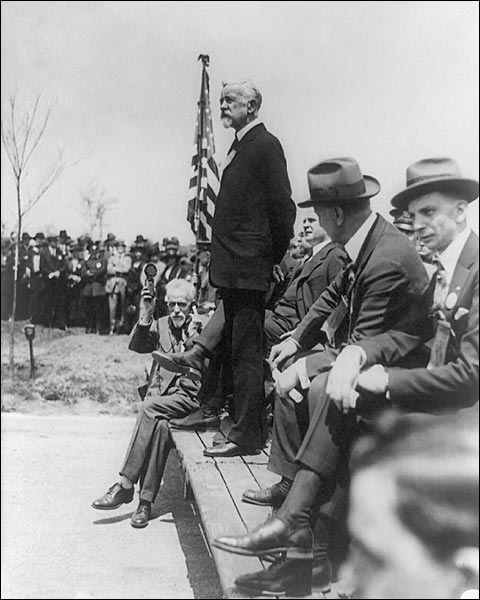
Oration delivered before the City council and citizens of Boston, on the one hundred and third anniversary of the Declaration of American independence, July 4, 1879 by Henry Cabot Lodge at the Boston Theatre.
We meet to-day to commemorate, with customs honored in the observance, our national birthday. In this matter of birthdays, nations resemble individuals. The recurring anniversary is hailed in childhood with rejoicing and pleasure. It marks a period of rapid advance, and denotes another step towards manhood, and all its fancied independence. In due time the youth comes of age. Technically and legally, at least, the period of tutelage and immaturity is at an end. But with the acquisition of freedom a gradual change begins. Few persons go so far as Dean Swift, who passed his birthday in solitude, as a day of mourning, fasting, and prayer. Yet, to almost every one, I think, as he goes on in life, the birthday suggests more and more serious reflection. Gradually we turn our eyes, when the day arrives which closes each little cycle of our existence, from the future to the past. We strive more and more earnestly to draw from the departed years lessons which shall guide our footsteps upon the unknown pathway before us. If this be rightly done, it is at this period, when we have both a future and a past, that we achieve success.

So it is with nations. By the signatures of the Declaration of Independence we came into existence. By the signatures of the treaty of Paris, that existence was acknowledged in Europe. By the adoption of the Constitution, nationality, then only a possibility, became a probability, which, after many years, has ripened into certainty. Then came our boyhood, and the struggle to cast aside the colonial spirit, and shake ourselves free from the influence of older and stronger nations. This was a longer and more arduous process than we can readily realize now. If the world had been at peace, our task, wonderfully difficult under any circumstances, would have been somewhat simplified; but everything seemed to combine against us.
Civilized mankind was in the throes of the French revolution. Through the first period of that awful convulsion Washington and Hamilton and Adams steered us successfully into the haven offered by the peace of Amiens. There was a short lull, and then the tempest raged again more violently than before. The old pilots were gone, and there was no one who could fill their places in such stress and peril. We were the only important neutral nation in the world, and our rich and defenceless commerce was an inviting prey. We broke from our moorings, and drifted out upon the stormy seas of the Napoleonic wars, assailed by all, befriended by none. It was painfully evident then that we were still children, and still in tutelage, intellectually, if not physically. To our shame be it said, both political parties made it their principal business for ten years to accuse each other of foreign predilections. We displayed at every turn the violent anger and infirmity of purpose which characterize the headstrong and impetuous boy, whose powers are yet untried, and who lets " I dare not wait upon I would." It was a sorry time. . But the previous years of peace and union had not been useless. After sore humiliation and bitter insult had been tamely borne by the country a national party at last came into existence. They pushed aside the old leaders and the old provincial feelings, and resolved to fight. They acted blindly, hotly, and, in many ways, unwisely. They were not Washingtons, and could not imitate his policy. But they took the ' methods of the Federalists and the theories of the Democrats, and determined to assert their nationality by arms. In so doing they hurried the country into a desperate and losing war. They brought the Union to the verge of dissolution. They abandoned by treaty everything which they had sought to obtain by force. But they vindicated the national existence, they proved the fighting qualities of the race to be as fine as ever on sea, and at last on land, and they broke once for all the fetters of colonial thought and tradition. They did their work roughly and ignorantly, but they were right at, bottom, and by the treaty of Ghent we came of age.
Then followed a period of wild exuberance and exultant hope. By the almost magic growth of material prosperity, by the rapid spread of civilization, and by the new-born consciousness of nationality, men's minds were filled with visions of a political millennium. We became imbued with the belief that we had a great mission. All humanity was to come as to the promised land, and be relieved. The fertile imagination of Henry Clay devised the scheme of uniting all American States. This human freedom league, controlling the western hemisphere, was to resist the Holy Alliance of emperors and kings, and bring in the new world to redress the balance of the old. Doubts as to our system, or as to the perfection of humanity, when freed from oppressive government, were regarded as heresy. We were to reorganize society, and change the destiny of man. In our vanity, our self-confidence, our unwillingness to learn or to recognize and correct our faults, above all, in our morbid sensitiveness to ridicule, we showed only too clearly our youth and inexperience.
But, while we were rejoicing and looking forward to the beneficent and enchanted future, where our dreams were to become realities, a dark cloud was gathering over the prospect. Gradually it became evident that two distinct social systems had grown up within our borders, which were so wholly irreconcilable that even this broad land could not afford room for both. One must perish that the other might survive. With every advancing year the immutable laws of economy and industry widened and deepened the gulf between the opposing systems, and strengthened one side while they weakened the other. Free labor was stifled in an atmosphere where slaves breathed, and free labor held in its hands the destiny of the republic.
There might have been a time when this awful problem could have received a peaceable solution; but, when men were at last awakened to the facts, and prepared to deal with them, it was too late. Beneath the baneful influence of the slavery struggle, politics and public men degenerated, and the old statesmanship of the republic withered away. Great leaders, in Congress and elsewhere, cried, "Peace, peace;'' but there was no peace. Our social problem was a Gordian knot. We followed the example of Alexander, and untied it with the sword.
The greatest war of modern times, since Napoleon fled from the field at Waterloo, and all the far-reaching results of such a war, have made sad work with our illusions. They are gone, like our extreme youth, and we begin to turn our look backward for instruction as to the journey which once seemed so easy and so full of promise. We have reached the second stage in our national birthdays. The time for reflection has come. If we can profit by the teaching of the past, although the future no longer looks either so golden or so certain as of yore, we may still find in it a greater, better, and truer success even than that which once filled our youthful imaginings. On this day of the year it especially behooves us to make up our accounts and see how we stand. We may well pause for a moment in our hurried, nervous, busy life to contemplate the years which have gone, and see what we have done with them. We are growing old, old enough to have a history, old enough to study it carefully. Let us take, then.
That great, wise book, as beseemeth age,
While the shutters flap as the crosswind blows,
And we turn the page, and we turn the page,
Not verse, now, only prose.
We are in the very prime of life as a nation. We are still young, still growing, still plastic and able to learn. But we have also passed the period of immaturity; we are vigorous, powerful, rich, and masters of a continent. We have made for ourselves a history, and we have our heroes and our heroic age, — an age full of human passion and human error, but great by its struggles and its conquest of difficulties.
We are wont to revert to the war for independence as our most glorious time. So, in some respects, it was. But the Declaration of Independence is eclipsed by the adoption of the Constitution and the organization of the government. It is better to create than to destroy. If we had fought the Revolution merely to obtain the wretched Confederation, and then dissolve into petty and jarring States, it would have been more honorable to have remained an integral part of the great empire of England. But this was not to be. We proved ourselves worthy of our inheritance, and capable of the moderation, temperance, and foresight which resulted in the Constitution. With the inauguration of Washington our national existence became a fact, and to the history of-, our career from that time to this we must look for guidance and instruction.
Although history, as a science, is still in its infancy, we have gone far enough to perceive a few great laws of human development, and from these, as they are the greatest and simplest, we learn the most, our own history we can easily detect the governing forces which have shaped our destiny, and struggle for victory. Two great conflicts of opposing principles have gone on here side by side. Nationality and separatism, aristocracy and democracy, are the contending forces which have made the political history of the country, and been felt throughout society and all its manifold forms of activity. All these forces existed in the States of the Confederation. They were present at the debates on the Constitution, and, from the foundation of the government, they have battled for the great prize of its possession and administration.
In the old system of the Confederation the separatist principle was supreme. Every State looked out for its own immediate interest with selfish and short-sighted ingenuity. The general government was despised and rejected. Anarchy seemed at hand. By a grand effort the wisest and most patriotic men framed and carried the Constitution. They succeeded, by means of judicious compromises, in "extorting from the grinding necessity of a reluctant people" a bare assent to the new scheme. Whatever glosses may now be put upon the Constitution, and upon the debates which preceded it, there can be no doubt that it was regarded at the time not only as an experiment, but as an agreement. Irrationality had but a feeble life in 1789, when the first Congress met in New York. There is no need to dwell upon the growth of the national principle embodied in the Constitution, or the phases of the conflict which ensued between that principle and the older one of State sovereignty. They, at last, contended for dominion sword in hand, and the events which led to four years of civil war are as familiar as a twice-told tale.
Everyone knows that, with each advance of the national power, the separatist spirit started up with fiercer menace and contested the ground. Sometimes the State prevailed, and sometimes the nation. Finally the rights of States were appropriated to the service of slavery, which gathered to itself every interest and every passion almost of which human nature is capable. At last slavery drew the sword of State rights and struck at the national existence. Then it was seen that the Constitution had silently done its work. The puny infant of 1789 had become a giant. When the bit of bunting which typified national existence was assailed the national spirit burst forth. Men were ready to bear with slavery and with all else, but there was one thing they would not part with, — their nation. The strong instinct of nationality started up and filled the hearts and minds of men. Like other instincts it found no exact expression; it gave rise to no formula, but the strength of the people was in it, and was resolved that the Empire of the West should remain intact. All else might perish — that should not. Whether for good or ill, the nation should remain united, the empire should not be shattered into jarring and discordant States. In this spirit the battle was fought and victory gained. Whatever else might come to pass, the Union under one flag was assured so far as human exertion and human sacrifice can assure anything.
So much of the long struggle is over. That we are a nation, and not a confederacy, has been decided by the dread arbitrament of the sword. We may again have civil war, — which God forbid! — but we shall not fight for our national existence. If we do fight, it will be for the possession of the national government, not for its overthrow. The national force, social- and political, is supreme.
The history of the great conflict is familiar, but it is well to call it to mind and dwell upon its results and lessons. We owe our existence as a nation to the Constitution, and to its silent work during three- quarters of a century. Our first feeling ought to be one of gratitude to that great instrument, and to the men who framed it. Such gratitude, however, can be expressed only by reverence for its provisions and scrupulous observance of its limitations. Herein lie the merit and value of a written constitution, if it has any, and who can doubt this when its work is considered? Formed by wisdom and patriotism, the Constitution rises up over the warring passions of party, to check and to control. There is the rule of action for the majority; there, and there alone, can the rights of the minority find shelter and protection.
The Constitution, if we heed its provisions, gives time for cool second thought, and, as nearly as possible, personifies reason and law, staying the action of excited force. The man or the party who violates it endangers our liberties. They are the enemies of the national charter. The greater the majority which overrides its provisions, the greater and the more unpardonable the sin, for the Constitution has within itself means to remedy legally and deliberately its own shortcomings.
Foreign critics have sometimes found fault with our excessive reverence for the Constitution. We do well to venerate that which has made us a nation. But let us beware of mere lip-service, and take care that in practice we submit to and observe it. We are too ready to infringe both the letter and the spirit of the constitution in the excitement of party contests. Nothing can be more fatal, for within its sacred limits lies the well-being of our political system.
Within those limits, too, lies the defeated principle in the great conflict between nationality and separatism. In the last decisive struggle the rights of States were sorely wounded. It could not have been otherwise, when their most zealous advocates used them as the sword and shield of slavery, and dashed them against the strong rock of national existence. The injury then suffered by the rights of States is one of the gravest results of the war, simply from its effects upon our minds and habits of thought. "We have been insensibly led to regard a violation of State rights with indifference, if not with approval. The principle of States' rights is as vital and essential as the national principle itself. If the former, carried to extremes, means anarchy, the latter, carried to like extremes, means centralization and despotism. So long as we have the strong barrier of the States, we are safe from usurpation and plebiscites. Here in the North, States' rights have naturally become words of evil significance, and are even used to revile political opponents. This is not only bad in itself, but it involves an amount of historical hypocrisy which is intolerable. The most meagre outline of our history suffices to show unmistakably that the separatist principle has existed everywhere, and has, at some time, burst forth everywhere into dangerous activity. If this teaches nothing else, it should at last enforce the wholesome doctrines of consistency and charity.
That separatism should have existed everywhere was not only natural but inevitable. The government of each State was old, familiar, and beloved when the Union was formed. The State represented "the past. With its existence were entwined all the memories and traditions which carried men back to tile toils and sufferings of their hardy ancestors, who bad made homes in the wilderness that their children might be free and receive a continent for their inheritance. The hearts of men were bound up in their States. The Federal government at first appealed only to their reason or their interest. To their States they turned as the objects of their first allegiance. This sentiment knew neither North nor South, East nor West. Nothing is more false than to associate the doctrine of States' rights with any particular part of the country, or exclusively with those States which last invoked its aid. Nothing is plainer than that the States and the party in power have always been strongly national, while the minority, call it by what party name you will, has as steadily gravitated toward States' rights.
There has never been a moment of peculiar stress and bitterness when the truth of this has not been brought home with sharp distinctness.
Washington and Adams and Hamilton were strong nationalists, and vigorously supported a liberal construction of the Constitution. The opposition, led by Jefferson, resisted the central government, advocated strict construction, and leaned upon States' rights. But the wheel revolved, and Jefferson became President. He retained in office all his old theories, but his practice was that of his predecessors. No one ever pushed the national power further, or strained the Constitution more boldly, than Thomas Jefferson. The famous alien and sedition laws of the Federalists paled before the stringency and oppression of the enforcement act, which almost drove Massachusetts into rebellion. Both measures were said to be demanded by national safety; both were the work of a national administration, and they were severally carried through by parties of diametrically opposite principles. On the other hand, the Federalists, once out of office and a hopeless minority, drifted into States' rights, and used them freely against the national government. The Union was never in greater peril than in 1814, when New England threatened secession unless the administration and ruling party yielded to her demands. With characteristic caution, she stayed her uplifted hand and waited a little longer. The wisest and most temperate leaders among the Federalists put aside the more violent, in order to guide and check the separatist movement, and thus maintain a control which open opposition would have destroyed. But no one then doubted either the meaning or the danger of New England's altitude. If the blow had fallen, the Union would have been dashed in pieces, without hope of recovery.

States' rights belong to no party and to no State. They are as universal as nationality; and that they are so is proof of their value. But they go much deeper than their name implies. They involve a principle as old as the race itself. This principle was born in the forests of Germany, is recorded in the pages of Tacitus, and came with the wild Teutonic tribes across the channel to Britain more than a thousand years ago. It is the great Anglo-Saxon principle of local self-government, and is the safe- guard of our liberties now, as it has ever been in the past. Without it there is no health in us. It should be more jealously watched than any other, because the tendency in large communities is always towards centralization. We see illustrations of this tendency every day, in the growing habit of both parties to judge every question according to its expediency, and not according to the constitutional principles, which they, as parties, are supposed to represent. There seems to be no desire anywhere to oppose a measure, simply and solely because it leans more toward centralization than is warranted by the Constitution. This tendency is full of peril. Our government is a system of checks and balances. Destroy one element, and the whole fabric falls. Nationality is strong and safe. Our most important duty is to protect our local rights, wherever they exist, and feel as the colonies did when the Boston Port Bill passed, that the cause of one is the cause of all.
Two lessons are clearly written on the pages which record the strife between the inborn love of local independence and the broader spirit of nationality created by the Constitution. One is reverence for the Constitution; the other, a careful maintenance of the principle of States' rights.
Let us turn for a moment to the other great conflict, which has gone on side by side with that between nationality and separatism. The opposing principles of aristocracy and democracy, of government by part, instead of government by all, of class- rule, in contradistinction to the rule of the whole people, have entered more deeply into our manners, habits, modes of thought, and daily lives than the purely political forces. The latter are better understood and appreciated, but the former, silently and almost unnoticed, have striven to possess and retain every nerve and fibre of the social and political body. Incidentally the conflict between aristocracy and democracy became involved in that between nationality and separatism, and met its fate upon the same field; but its history and origin are, nevertheless, wholly independent.
We are too apt to forget that an aristocracy of strong social and political influence existed in a greater or less degree in every one of the thirteen colonies when they threw off the yoke of the mother- country. In Virginia and the southern States there was a pure aristocracy in theory and in fact. It rested upon the firm foundation of great landed estates, a tenantry of slaves, and broad class distinctions. Government was wholly in the hands of this ruling class, and the Virginian system continued to sway the South until the day of Lee's surrender. In New England, on the other hand, the political system was democratic, and modeled upon the church system of the early Puritans. Here, too however, there was an aristocracy from which our early leaders were chiefly taken; but their power and influence rested only upon consent. They were permitted to guide and govern, deference was yielded to them, and official position freely given, but solely on account of ancestral service to the State, of ability, wealth, or learning. Such an aristocracy may be an ideal one, but its tenure of power is precarious, and its supports are frail. The middle States contained both Virginian and New England elements. Great families, owning vast estates, dominated New York, but mainly by dexterous management of the masses; while, in Pennsylvania, the democratic principle had the advantage, and the aristocracy, from its own supineness, seems to have had less power even than in New England.
This wide-spread, aristocratic element, which was so powerful a century ago, made itself deeply felt in all matters of government. We find in the early State constitutions ample provisions for the representation of the upper classes, and for the restraint of democracy, as well as many and various limitations upon the suffrage. The aristocratic principle came out strongly in the convention which framed the constitution of the United States. “We are too democratic, and means must be found to check the spread and the action of democracy," was the cry of many members in that convention, including some men who soon after followed the Jeffersonian standard. The great party which carried the Constitution, organized and set in motion the government, held possession of it for twelve years, and nearly overthrew it in their last struggle for power, was an aristocratic party, and wished to build up and consolidate a ruling class.
They aimed at the creation of an aristocratic republic, and a strong and energetic central government. They shrank with undisguised horror from the idea of universal suffrage, and, embittered by the spectacle of the French revolution, regarded pure democracy as equivalent to anarchy, and, as of necessity, a government by the worst elements of society. They fought manfully to maintain and carry out their theory, and they failed. They were contending with an irresistible social and political force, and the accession of Jefferson not only marked their defeat, but accomplished a complete revolution in our theory of government. From that time the democratic principle was supreme. But customs die hard. Even after the vital principle is gone habits live on. The theory was established, but more than a quarter of a century elapsed before the practice was changed. There was still a ruling class from which the men to fill high office were for the most part selected. Birth, education, social position, wealth, and training still continued to be most important requisites for a statesman. At last the second revolution came, and practice was made to conform to theory. With the election of Andrew Jackson, qualities, inherited or acquired, which raised a man above his fellows, and had been supposed to imply peculiar fitness for public life, were cast aside forever as tests for employment in the national service.
Ability, property, training, reputation, were not only no longer required, they became positive disadvantages. A “self-made" man, who had started with nothing, and worked his way up, despite ignorance and poverty, from the log-cabin in the backwoods, was considered to have better claims, solely on account of his antecedents, than one who had been bred to the profession of state-craft, and had every opportunity for improvement which wealth and care could give. The new practice, carried by the impulse of victory to extremes, was every whit as false as the old. It simply reversed the ancient order, and declared that favor should be extended to those who had formerly stood at a disadvantage. Class discrimination was as strong as ever, in a new form. But all class distinctions are foreign to the spirit of our political system, no matter what portion of society is the favored one. They are utterly alien to the theory of administration which was accepted and laid down at the outset as the guiding principle of our government, and in accordance with which the best men, and the best men only, were to administer public affairs and be properly remunerated for their labor. This was a business theory, upon which our system was founded, and it worked capitally until, as was said by Mr. Evarts, I believe, the corollary was added, that one man was just as good as another. It was this corollary which was swept into power with Andrew Jackson, and it was anything but a business theory. It never obtained for a moment, in any walk of private life, where fitness has always continued to be the test of selection for places of trust and profit. In public affairs alone it was forced into practical operation. We are still reaping the results of this distortion of democratic principles.
It would, however, be a mistake, to suppose that, because the national government had at last become purely democratic, class rule and aristocracy were therefore at an end. The Virginian system still prevailed in the South, and still held sway at Washington. The aristocracy of Virginia had perceived at an early day that they could not gain supremacy without northern allies. These they obtained with great sagacity and perfect success. They could form no alliance with the northern leaders in the days of the Federalists, so they turned to the masses. The people of the Northern States were altogether democratic, and had no real sympathy with slave-holders and great landlords. But the Virginian system was impregnable at home, and the Virginian leaders stepped boldly forward as the friends of humanity and equality, and as the advocates of doctrines which, if applied to their own State, meant total destruction to the very system that gave them power. Under the cloak of democratic principles, Virginia divided the North, and the curious spectacle was presented of the aristocratic portion of the country ranged on the side of democracy, while aristocracy made its stand and fought its last desperate fight under its true colors in the most thoroughly democratic States.
The Virginian policy worked admirably. For twenty-four years Virginia retained the presidency. For thirty-five years more the South controlled the national government. Under the withering and debasing influence of slavery the Virginian aristocracy rapidly degenerated. They ceased to be the class which had produced Washington and Marshall. Virginian aristocracy broadened into a southern aristocracy, and lost the qualities which had once made them so much more than mere slave-drivers and plantation lords. The aristocratic force remained, but its graces and virtues had departed, blighted by slavery and by the constant defence of what men in their hearts knew to be a great and crying iniquity. Still they held on, while violence and truculence usurped the place of courtesy and good-breeding, and drove out those other attributes which had once given the southern leaders a high and acknowledged position.
But other forces were at work, and the opposing systems met at last in battle. On the field of Gettysburg the democracy of Plymouth and the aristocracy of Jamestown came together in arms, and the principles of the Puritan triumphed once more over those of the Cavalier. As in the days of Charles I., aristocratic principles had allied themselves with a bad cause, and met with the defeat which that cause merited. The last class government was utterly swept away. We are finally democratic throughout the length and breadth of the land.
With the civil war the first era of our history closed. It is settled that we are to be one nation, and we have established a pure representative democracy. These results have been accomplished by tremendous sacrifices and exertions, and they bring with them a mighty responsibility. We have undertaken a gigantic task. We are making the greatest experiment in government ever attempted. We have built up an empire so great that, whether for evil or good, it is a chief factor in the affairs of civilized mankind and of the world. We have gradually evolved a political and social system which has, on the whole, produced a greater amount of human happiness and well-being than any other. We have done more to raise the condition of the average man than any other nation. To us belongs the solemn duty of maintaining this system, and of making this experiment of a great representative democracy succeed.
It is a momentous and difficult task. We cannot escape it. We cannot retrace our steps. We must either maintain our system as it is, or plunge blindly forward. We have reached the last point of safe progress in government. We have conferred sovereignty upon every man in the community, and, unless we include women and children, there is no possibility of further expansion in this direction. The step from democracy is to socialism, and although socialism is not an immediate danger in the United States, it here and there rears its ugly head and breathes its false spirit into our laws and party resolutions. It must be crushed out before it gathers strength; for socialism means anarchy, and anarchy can have but one result, the order of military despotism. Our position is difficult, and fraught with peril, but we have proved ourselves capable of great things, and we have no reason to falter. Yet, if we wish and mean to succeed, we must lay aside careless indifference as well as fear, and take seriously to heart some of the pregnant lessons of history.
The great secret of the political success of our race lies in its conservatism, in its ability to reform and not destroy in order to create anew. "We have adapted our forms of government to the changing necessities of the times, by clinging to the past until sure of the future, by holding fast the good and rejecting only the bad, and by sturdy contempt for inconsistencies, provided the system practically worked well.
But, in this country, by our youth, by our success, and by the marvelous changes we have wrought, we have been led to forget these principles. We have become too apt to concede that a change is worth trying, simply because it is a change. We are too ready to admit that everything is open to argument, instead of adhering, in some measure, at least, to the practice of our ancestors, who believed that there were certain laws and institutions upon which all civilized society rested, that were not susceptible of discussion. Let us revert to the traditions of our race, and practise a little more wholesome conservatism. No change should be made in our political system until it has been well considered and conclusively demonstrated that it is not a change for the worse. Progress is a fine word, but it is not necessarily a good thing. It may be progress in evil as well as in good. It may be as bad as reaction, and much worse than standing still.
In another respect, which nearly affects the success of our great democratic experiment, we have departed from the maxims of our ancestors and of the founders of the republic. No men were ever more skilled than they in the difficult art of free government, and they knew well that the sphere of legislation was not boundless. They believed that legislation could assist human effort by giving security to all, and thereby extending the best opportunities for great achievements. But they taught the doctrine that the individual man should rely upon himself, and not upon his government, for well-being and success. They were firmly convinced that legislation could not be a panacea for every ill that flesh is heir to; that it could not prevent human passion and error, and their legitimate results, or free men from misfortune and from the consequences of their own folly and mistakes. The fathers of our system had learned by bitter experience that legislation should be restricted to the very well defined field where effective action is possible, should leave room for every man to exert his talents, and, above all things, should not be meddling and paternal. This was sound, wise doctrine. But there is now a growing tendency to invoke legislation to cure the results of our own blunders; to regard it as a universal remedy for every mishap, and to carry it out of its proper sphere and force it to do work which belongs to the individual man. Such helpless leaning upon legislation is false in theory, dangerous in practice, thoroughly unmanly, and as peculiarly un-American as anything can possibly be. It is diametrically opposed to the independent, self-reliant spirit which has made America what she is. Strong,' masculine races have no need of paternal legislation. It is their worst enemy.
But there is one danger to our democracy which far surpasses all others in gravity and importance. When the government was founded, although there was a well-defined aristocracy, the social and economical conditions were much more favorable than at present to the successful establishment and working of a pure democracy. Great fortunes were rare, and extreme poverty was almost unknown. Men stood, as a rule, pretty nearly upon an equality in the matter of property and physical well-being. Agriculture and trade were the only pursuits of the community. There were no great centres of population. The largest cities were hardly more than small towns. Huge masses of capital were not collected for the prosecution of vast enterprises. Life was simple, and class distinctions rankled in no man's breast, despite the power and position of the aristocracy.
As the years have rolled on we have become a pure democracy, and, meantime, all the social and economical conditions have radically changed. Immense fortunes are no longer rare, and desperate poverty is only too common. Great corporations, controlling vast amounts of capital, have come into existence. Great cities have grown up, and complicated industries have spread, or are spreading, over the whole country. From a small society, where material equality reigned, simple in its tastes, habits and pursuits, we have become a great nation, with all the intricate and delicate machinery of a high and luxurious civilization, filled with glaring inequalities of condition.
In this state of affairs there is one thing absolutely fatal to the continuance of democratic government, and that is, strife between classes. Under the old and equal conditions this was not to be feared. Nearly everybody had a stake in the peaceable existence of the country and in the continued stability of the government. All men knew, with the keen instinct of those who have something to lose, the ruin which lurked in social disorder and in any invasion of the rights of property. The population then was also largely rural and widely scattered, and such inequalities as there were did not come home to men by daily and unavoidable contact. Now, enormous and defenceless wealth dwells side by side with hopeless poverty. In the progress of our wonderful development we have brought together a great deal of very inflammable material. Let us see to it that it is not ignited, as it might easily be if one class is aroused against another.
Here is the terrible foe of our system. Here is the enemy which, once let loose, will bring our fair experiment crashing in ruins about our heads. Scrupulous protection of private rights and private property has been the great secret of our success and the chief glory of our popular government. This essential principle can be destroyed not only by force, which is little to be feared, but quite as effectually, although more insidiously, under forms of law. In either case the meaning is the same. It is one part of society attacking the other, and if this war between classes comes the present scheme is ruined. It begins with statutes and constitutions, and ends with the bayonet and the barricade. While political divisions run up and down, we are safe; but, when they begin to run across society, the end is not far distant.
To the diminution, and, if possible, to the removal, of this danger, which can now be easily dealt with, our best efforts should be directed. A brand should be set upon the man who strives to stir up war.